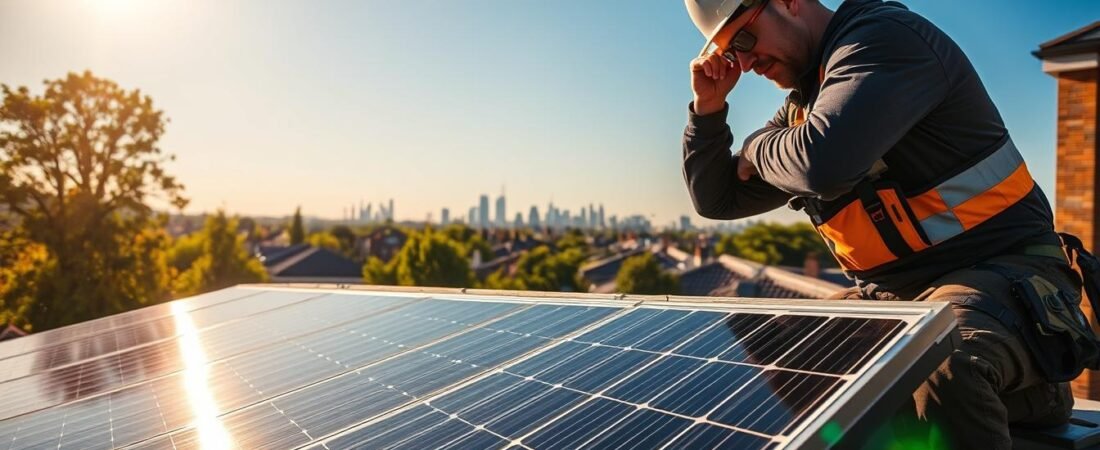
This guide walks homeowners through every step, from first quote to flipping the switch. It explains why many locals are comparing options now and gives clear choices on system size, equipment, financing, and warranties.
Who this is for: owners facing rising electric bills who want predictable costs and long-term savings. You will learn what drives quotes, the 2026 average cost of $3.23 per watt, and how to judge installers and service.
Key terms are defined up front: system size in kW, price per watt, net cost after tax credit, and the difference between grid-tied and battery-ready setups. These quick definitions cut confusion early so you can compare offers with confidence.
Important mindset: think of this as a 25–30 year asset. Choosing the lowest quote alone can backfire if warranties and service fall short. Our goal is to help you compare companies, quotes, and timelines without any pressure.
Local steps like permitting, inspection, and utility interconnection affect schedule and outcome. Later sections cover timeline, incentives, ROI, choosing the best solar company, and basic system design.
Solar panel installation birmingham: what to expect as a homeowner in 2026
Knowing the usual steps from first quote to permission to operate prevents surprises. Below is a homeowner-friendly timeline and practical notes on site visits, permits, equipment, install days, and final approval.
Typical project timeline
Week 0–2: Compare quotes and sign a contract. An installer schedules a site visit and begins permit paperwork.
Week 2–6: Permits approved and equipment ordered. Lead times vary by brand and inverter type.
Install week: Crew works 1–3 days: racking, wiring, mounting modules and inverters, and final checks.
Post-install: Municipal inspection and utility interconnection review must clear before you get permission to operate.
What a site visit covers
Visit items: roof condition, shading, attic access, electrical panel capacity, and measurements for layout. Virtual visits speed the process but may miss hidden issues.
Permits, equipment, and installation days
Installers usually handle permits and most paperwork. Homeowners may need to provide ownership documentation or HOA approval.
Equipment choices affect start dates. Ask for a written start window and acceptable substitutions.
Typical install order: racking → wiring → modules and inverters → cleanup. Expect short power interruptions and roof access for the crew.
Inspection and interconnection
A town or county inspector checks safety and code compliance. The utility inspects or reviews paperwork before granting permission to operate. No grid export until approval arrives.
Timeline risk checklist for homeowners
- What causes delays: weather, permit backlogs, or equipment substitutions?
- Ask for firm dates or penalty clauses for late starts.
- Who contacts the utility and handles interconnection fees?
| Phase | Typical Duration | Who Handles It | Key Questions |
|---|---|---|---|
| Quotes & Contract | 1–2 weeks | Homeowner & installers | Are permits included? Start window? |
| Site Visit | 1–7 days | Installer | Virtual or in-person? Roof issues? |
| Permits & Equipment | 2–6 weeks | Installer | Lead times for equipment? Substitutions? |
| Install & Approval | 1–4 weeks | Installer, Inspector, Utility | When is permission to operate granted? |
How much solar panels cost in Birmingham in 2026
Start with clear numbers so you know what a typical homeowner might actually pay in 2026.
Headline pricing — what you might pay in 2026: The local average is $3.23 per watt. After the 30% federal tax credit, a representative 7.2 kW system nets about $16,279. That figure bundles equipment, labor, permitting, and basic warranty costs.
The local $/W is higher than the U.S. average of $3.03 per watt. Labor, market demand, and local permitting timelines commonly push price differences. For local pricing context, see this local pricing data.
Cost by system size (net after 30% tax credit)
| System size (kW) | Net cost ($) | Estimated annual production (kWh) |
|---|---|---|
| 4 kW | $10,836 | 4,800–5,200 |
| 5 kW | $12,530 | 6,000–6,500 |
| 6 kW | $14,238 | 7,200–7,800 |
| 7 kW | $15,925 | 8,400–9,100 |
| 8 kW | $17,640 | 9,600–10,400 |
| 9 kW | $19,341 | 10,800–11,700 |
| 10 kW | $21,000 | 12,000–13,000 |
Why price per watt matters
Price per watt is the best apples‑to‑apples metric to compare quotes. It shows cost relative to output, not just total dollars. Factors that move this number include equipment quality, inverter choice, roof complexity, and local labor rates.
Why bigger systems lower $/W but cost more overall
Larger systems often get bulk discounts on modules and wiring. Fixed labor and permit fees spread over more watts, so the $/W falls.
Still, a 10 kW setup costs more in absolute dollars than a 4 kW system because it uses more equipment and produces more electricity. Match kW size to your yearly electricity use so the system fits your bills and goals.
What drives your final solar quote in Birmingham
A handful of decisions—how much power you need and which gear you pick—drive the final price. The starting point is your electric bill: installers use past usage to size a system that offsets a target percentage of your consumption.
Your electricity use and system size
Higher monthly bills usually mean a larger panel system and a higher total cost. Smaller roofs or low usage can cut size but may raise $/W because fewer panels spread fixed costs less.
Panel type choices
Monocrystalline panels are more efficient and common for homes. Polycrystalline is slightly cheaper but takes more roof space and is less used today. Most residential quotes favor mono for long‑term value.
Inverters and key equipment
Inverters convert DC to AC and affect monitoring and performance. Microinverters or optimizers add cost but improve output on shaded roofs. Higher‑quality equipment raises upfront price but can boost production and durability.
Permits, inspection, and installer margins
Soft costs cover permits, inspections, and paperwork. These vary by project complexity and jurisdiction. Installer overhead and margins also explain why two reputable companies give different quotes.
Spotting low‑ball offers
Watch for vague equipment specs, missing warranty terms, or high-pressure sales. Prioritize confirmed specs, workmanship warranty, and the installer’s ability to service your system for decades.
Compare multiple quotes and verify equipment lists, production assumptions, and warranty details before you choose. For vetted services, see local installer options.
Solar incentives and tax credits available in Birmingham, AL
Understanding available incentives helps you budget and speeds up your payback.
Federal tax credit (2026): The federal credit equals 30% of your installed system cost. You claim it on your federal return for the year the system is placed in service. That one-line credit reduces your tax liability and lowers net cost.
Timing, paperwork, and common confusions
Claim the credit on the return for the year your system is active. Keep invoices and the install date handy for your tax preparer.
Many homeowners call this an Alabama credit, but Alabama does not offer a state tax credit. The 30% benefit is federal only. Ask your installer for a clear gross cost vs. net cost after credit breakdown so you know how much money you will actually pay.
- Check local rebates: Utility or municipal programs can add savings but vary by location.
- Use a calculator: A cost and savings calculator helps model payback, but confirm assumptions (rates, production, net metering).
- Verify changes: Incentives can change over time; confirm the current rules before you sign.
Next: These incentives speed up ROI and shorten payback, which we detail in the ROI section.
Is solar worth it in Birmingham right now?
Examining an actual quote makes the long‑term payoff easier to understand.
Real example: A 5.8 kW system with estimated generation of 8,539 kWh shows a gross cost of $18,734 and a net cost after the federal tax credit of $13,114. Estimated payback time is 10.5 years and the total value of avoided utility costs over 25 years is about $42,252.
How payback and avoided costs work
Payback means the year when cumulative savings equal your net cost. This example reaches payback in about 10.5 years under cash purchase and full retail net metering assumptions.
Avoided utility costs are the main long‑term benefit. Every kWh produced replaces a kWh you would otherwise buy, so production multiplies into decades of savings.
Benchmarks and practical checkpoints
- Local benchmark: The average homeowner in the area saves about $1,767 per year (EcoWatch, Jan 24, 2025) — use that as a reality check.
- Compare to other uses of capital: Paying down debt, routine home upgrades, or conservative investments may have shorter or longer returns. A ~10–11 year payback is competitive for a 25‑ to 30‑year asset.
- Worth‑it checkpoints: good roof condition, low shading, plans to stay at least 10 years, and ability to claim the full tax credit.
Next step: Validate production and net‑metering assumptions in your quote, and compare quotes on an apples‑to‑apples basis. For local cost context, see this cost resource and learn about reputable installers on the company about page. For broader pricing data, check this local cost guide.
Choosing the best solar installers in Birmingham
Picking the right installer starts with knowing what lasting service looks like. For most homeowners, the best solar company is not the cheapest bidder. It is the one that offers clear communication, quick responses, and a promise to stand behind its work for 25+ years.
What “best” really means
Best means dependable workmanship, transparent warranties, and an easy customer experience after the crew leaves. Longevity matters: a company that lasts reduces the risk of unanswered warranty claims when parts age.
How top lists rank installers
Reputable lists (EcoWatch reviewed 1,500+ companies) score installers by reviews, BBB ratings, years in business, certifications, warranty terms, services offered, financing options, and availability.
Look for strong online reviews, clear warranty durations (25-year product/performance and ~10-year workmanship), and verified certifications.
Local short list to research
- Solar Technology Alabama
- Eagle Solar & Light
- Vulcan Solar Power, LLC
- Small Tech Solar
Use these names as starting points. Verify service area, licensing, and recent customer reviews before you commit.
Questions to ask during a consultation
- Who will do the work — employees or subcontractors?
- Which equipment models are proposed and why?
- What production assumptions back the estimated output?
- How are change orders priced and approved?
- Who do I call first if performance drops — the installer or the manufacturer?
- What are expected service response times and warranty claim steps?
Tip: Collect at least three quotes and compare them side by side using the same assumptions. Review scores and recent reviews to confirm real customer experience before signing.
Comparing quotes, financing, and warranties like a pro
A careful side‑by‑side review of offers reveals hidden costs and real value.
How to compare quotes apples-to-apples
- Price per watt, system size (kW), and estimated annual production (kWh).
- List exact equipment model numbers and inverter type; note assumed system losses or escalators.
- Check whether add‑ons (critter guards, monitoring, roof work) are included in the cost.
Warranty coverage to prioritize
Prioritize a 25‑year product and performance warranty and at least a 10‑year workmanship roof/penetration guarantee.
| Warranty type | Why it matters |
|---|---|
| Product | Protects defects and materials |
| Performance | Ensures expected energy over decades |
| Workmanship | Covers labor and roof repairs |
Financing and contract essentials
Compare cash, loans, and third‑party options. Ask about rates, fees, and who owns incentives.
- Document exact equipment, total price, payment schedule, and installer responsibilities.
- Set firm timeline targets and change‑order triggers.
- Quote red flags: missing model numbers, vague warranties, or unclear interconnection duties.
System design basics: building the right solar panel system for your roof
A good system design starts with a honest look at your roof and how much sun it actually receives. That reality drives production and long‑term savings.
Roof suitability and sunlight exposure considerations
Orientation and pitch matter. South‑facing roofs often yield the most energy. East or west faces work but produce different daily profiles.
Watch for shading from trees or nearby buildings. Even a small shaded area can cut output significantly, so ask for a shade analysis.
Check roof age and condition. Installing on an old roof can force rework later and add cost.
Grid‑tied vs. off‑grid and where batteries fit
Most homeowners choose grid‑tied systems for cost and simplicity. Off‑grid setups need more equipment and careful sizing.
Batteries add resilience and let you shift electricity use, but they raise the budget and change the design. Think of batteries as optional insurance for outages or demand shifting.
Design tip: Request array layouts and a production estimate that lists assumptions. The right system fits your roof, meets your electricity goals, and keeps total cost reasonable.
Conclusion
Before you sign, a short recap keeps the most important steps front and center.
Follow the pathway: quotes → site visit → permits → 1–3 day install → inspection → utility interconnection. Use the 2026 benchmark of about $3.23/W and factor the 30% federal tax credit into net cost estimates.
Next steps: check roof suitability, gather 3+ quotes, and compare price per watt plus exact equipment and warranties — not just total price. Run a savings calculator and then verify production, net‑metering, and rate assumptions with your installer.
Pick an installer with strong reviews and long service history. Before signing, confirm model numbers, firm timelines, who handles interconnection, and change‑order terms. Small steps now protect decades of value and peace of mind.