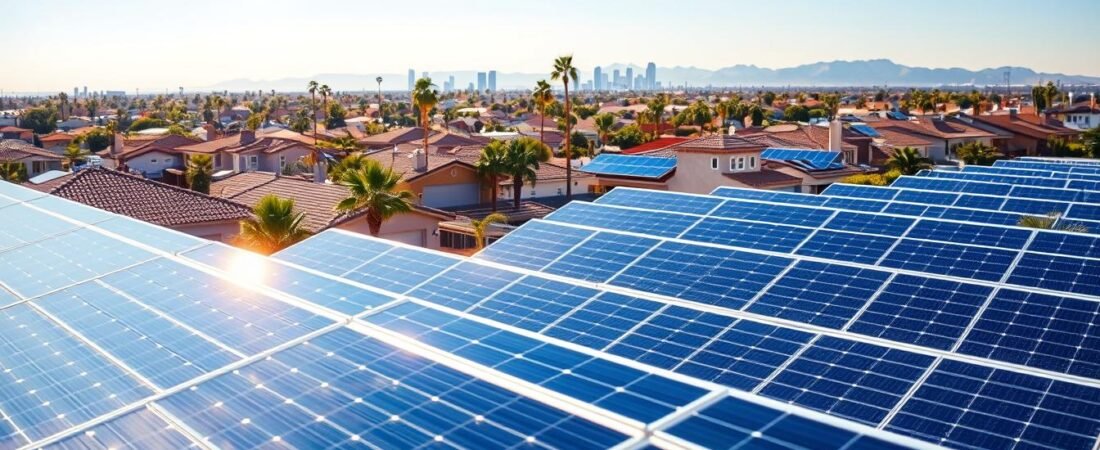
Ready to compare offers with confidence? This short guide sets a clear baseline so Bakersfield homeowners can avoid sticker shock and choose a lasting investment.
Local pricing often bundles equipment, installation, permitting and installer margin. In 2026, Bakersfield averages about $3.14 per watt, slightly above the U.S. average of roughly $3.03/W. A typical 7.2 kW system nets to about $15,825 after the 30% federal tax credit.
This introduction previews the buyer’s roadmap: current pricing, cost by system size, main price drivers, how to read a quote, incentives, payback, sizing and equipment choices.
Remember: an average price is only a starting point. Your roof, usage and equipment choices can move the final figure up or down. A cheaper upfront price may cut warranties or service, which matters for a 25–30 year investment.
For fuller local data and comparisons, see this brief guide at Bakersfield pricing overview.
What Bakersfield homeowners are paying for solar panels right now
A per-watt figure is the clearest way to compare proposals that bundle different gear and services.
Price-per-watt shows how much you pay for each watt of capacity. It removes confusion when quotes use different equipment, add batteries, or assume different system sizes.
Local benchmark: Recent local data lists about $3.14/W for 2026 versus a U.S. average near $3.03/W. For a typical 7.2 kW home system that translates to roughly $22,600 before incentives and about $15,825 after the 30% federal tax credit.
Other reports show near $3.50/W with a smaller 2.9 kW average, yielding roughly $7,037 total (2025). Those numbers differ because sources vary on sample size, assumed system size, whether batteries are included, and if figures are before or after incentives.
- Compare multiple bids from reputable installers and companies.
- Weigh cost solar against equipment quality, warranties, and service.
- Remember: once you know your household electricity needs, system size becomes the biggest lever on total costs.
| Metric | Local $/W (2026) | U.S. Avg $/W (2026) | Example 7.2 kW Total (before tax credit) |
|---|---|---|---|
| Reported $/W | $3.14 | $3.03 | $22,608 |
| Alt. report (smaller avg) | $3.50 (2.9 kW) | — | $10,150 (2.9 kW) |
| After 30% credit (7.2 kW) | Approx. $15,825 | ||
Solar panel cost by system size in Bakersfield
Here’s a quick size guide showing typical net prices for common residential systems after incentives.
| System size | Typical net price | Approx $/W |
|---|---|---|
| 4 kW | $10,752 | $3.84/W |
| 5 kW | $12,355 | ~$3.47/W |
| 6 kW | $13,944 | ~$3.24/W |
| 7 kW | $15,533 | ~$3.06/W |
| 8 kW | $17,136 | ~$2.67/W |
| 9 kW | $18,711 | ~$2.08/W |
| 10 kW | $20,300 | $2.90/W |
As size grows, the per-watt price usually falls thanks to bulk pricing and fewer fixed fees per watt.
However, larger systems raise total upfront costs because you buy more modules, bigger inverter capacity, and more wiring and labor. Installation time and permitting can take longer for bigger systems.
Side-by-side examples (5–10 kW)
These estimates show how total net price scales by size. Final quotes vary with roof complexity, equipment tier, and project timeline.
- 5 kW — $12,355 net; good for small families with moderate usage.
- 7 kW — $15,533 net; fits many average households seeking higher offset.
- 10 kW — $20,300 net; best for large usage or EV owners who want maximal offset.
Practical tip: Ask each installer for $/W, total installed price, net price after the 30% ITC, and a modeled production estimate. That ensures apples-to-apples comparisons when you request quotes.
solar panel cost bakersfield ca depends on these pricing drivers
Your final price depends on a handful of predictable factors tied to home use and gear choices.
Your electricity usage and bill history
How much energy you use and when you use it drives system size and output needs. A home with steady daytime use needs fewer modules than one that runs heavy evening loads.
Equipment choices: panels, inverters, and optional batteries
Equipment type matters. Higher-efficiency modules and premium inverters cost more but produce more over time.
Adding batteries raises upfront spend but can provide backup power and shift use during peak rates.
Labor, permitting, inspections, and installer margin
Soft costs—labor, permits, and inspections—often add a large share to a quote. Installer margin varies by company and job complexity.
Installer quality and long-term service expectations over 25+ years
Higher-quality installs reduce production losses and lower repair risk. Good workmanship and clear warranties protect your investment.
“Unusually low bids often mean something important was excluded. Ask what’s missing before you sign.”
| Driver | What it affects | Why it matters |
|---|---|---|
| Usage & bill history | System size, estimated savings | Sets how many panels and inverter capacity you need |
| Equipment selection | Performance, warranty, lifespan | Higher-grade gear gives better long-term value |
| Soft costs & installer margin | Upfront price variance | Permits, labor, and company overhead change quotes |
| Installer quality | Production and service outcomes | Good design and service avoid costly fixes later |
Practical tip: Match system design to real needs—EV charging, family growth, or HVAC upgrades—to avoid under-sizing and extra expense later.
Understanding your solar quote: what’s included and what’s not
Reading a quote like a buyer means verifying models, quantities, and every line that affects future service.
Equipment line items to verify
Ask for an itemized list showing each panel model, inverter type, and racking brand. Confirm quantities match the proposed system size.
Must-see entries: modules, inverter(s), mounting/racking, monitoring gear, wiring/conduit, and any main service work.
What a full installation should cover
Installation should include permits, utility interconnection, inspections, and final commissioning. It should also include app setup for production monitoring.
Note items often excluded: panel roof repairs, main panel upgrades, trenching, or tile replacement. Ask for allowances in writing.
Warranties and workmanship
Split warranties into two buckets: manufacturer equipment warranties and installer workmanship terms.
Why workmanship matters: a good warranty covers labor and repairs long after the equipment warranty expires.
| Line item | Included? | Typical note |
|---|---|---|
| Modules | Yes | Model numbers and qty must match |
| Inverter(s) | Yes | Specify brand and warranty length |
| Permits & inspections | Yes | Should be in base price |
| Roof work / upgrades | Sometimes | Often billed separately |
“Compare cost, timeline, and responsibilities across quotes so you avoid surprise bills later.”
Solar incentives and rebates that reduce upfront costs in Bakersfield
Federal and local incentives can cut your upfront price by a large, predictable share if you know how to claim them.
Federal 30% investment tax credit (ITC): This federal tax credit reduces the tax you owe by 30% of eligible project expenses. Eligible items usually include modules, inverter(s), racking, and installation labor. Claim the credit on your tax return for the year the system is placed in service.
Not everyone can use the full credit immediately. The benefit depends on your federal tax liability. If you can’t use the entire credit in one year, some taxpayers may carry portions forward under IRS rules. Check with a tax advisor for personal eligibility.
Where federal, state, and local programs differ
California does not offer a single statewide tax credit like the ITC. Instead, homeowners may find utility rebates, local programs, or upfront incentives from municipalities or nonprofits.
Tip: Ask each installer to list which rebates and incentives they will claim for you and which ones you must apply for personally.
Net metering and export credits
Net metering lets excess generation earn credits on your electricity bill. Export compensation rates and rules vary by utility and can change the long-run savings estimate.
Higher export rates mean faster payback. Lower or time-limited credits reduce projected savings, so confirm current utility policies when you compare proposals.
“Have installers provide an incentive snapshot in writing: what is guaranteed versus estimated.”
| Incentive | Typical benefit | How it’s claimed |
|---|---|---|
| Federal ITC (30%) | Reduces federal tax owed by 30% of eligible costs | Claimed on federal tax return for year of installation |
| Utility rebates | One-time rebates or performance-based payments | Applied by installer or homeowner to utility program |
| Net metering / export credits | Bill credits for excess generation | Handled via utility billing; varies by tariff |
Bottom line: Incentives and rebates can stack, but only when each program’s rules allow it. Get written details in every quote so you compare true net prices and expected savings.
Is installing solar worth it in Bakersfield? Payback period and savings
Payback period measures how many years it takes for avoided electricity bills to equal your upfront investment.
Why it varies: rate plans, export credits, and how closely system generation matches daytime usage change results a lot.
Typical payback timelines and what changes them
Published examples range from roughly 3.9 years to about 7.3 years. A ~5.9 kW example showing ~3.9 years assumed strong export credits and a cash purchase.
Longer payback estimates assume lower export value, higher upfront financing, or conservative production forecasts. Each factor can move the timeline by several years.
How 20–25 year electricity savings are estimated
Estimators model annual kWh production, apply a utility rate escalation, and subtract expected degradation (about 0.5–1% per year).
Resulting lifetime savings equal cumulative avoided utility charges. Ask installers for both conservative and optimistic scenarios.
ROI expectations: comparing avoided utility costs over time
Think of ROI as reduced electricity spend rather than a single lump-sum return.
- A higher upfront price can win if the system produces more power, has stronger warranties, and lower degradation.
- Request modeled years-to-payback, 20-year net savings, and an assumed rate escalation in writing.
“Compare a conservative and an optimistic scenario so you see a realistic range of payback and savings.”
How to size a solar panel system for your Bakersfield home
Gather a year of bills to turn your actual energy use into a realistic system estimate.
Using annual kWh usage to estimate system size
Start by totaling twelve months of kWh from your utility bills. Note summer spikes from air conditioning—those will raise the required system capacity.
How many solar panels you may need based on roof space and efficiency
Convert your annual kWh goal into required kilowatts. For rough math, divide your yearly kWh by 1,600–1,700 to find needed kilowatts in this climate.
Then translate kilowatts to hardware: a 350 W module needs about 17 panels to make a 6 kW system. Usable roof area, orientation, and obstructions change that number.
Production estimates: what a mid-size system can generate
A practical benchmark: a ~5.9 kW system can produce roughly 9,536 kWh annually. Site shading and pitch alter real output, so insist on an installer run a shade analysis.
- Roof checks: setbacks, vents, and skylights reduce usable area.
- Future planning: size up if you expect an EV or new AC to avoid costly add-ons later.
- Buyer tip: request each quote’s production estimate and offset percentage, then compare them alongside total price—not just the number of panels.
| Item | Example | Note |
|---|---|---|
| Annual energy | 9,536 kWh | Example output for ~5.9 kW |
| Approx. panels | ~17 (350 W) | Varies with wattage & roof usable area |
| Action | Shade analysis | Required for accurate production |
Equipment choices that change solar panel pricing and performance
Choosing the right hardware shapes both how much you pay and how much energy your roof will deliver over decades.
Monocrystalline vs. polycrystalline for residential roofs
Monocrystalline modules are more efficient and take less roof area for the same output. They are the most common on homes for that reason.
Polycrystalline modules cost less upfront but need more space and usually have slightly higher degradation. For tight roofs, the higher-efficiency option often gives better long-term value.
Inverter options and why they affect the final price
String inverters are the simplest and often the least expensive choice. They work well on unshaded roofs with uniform orientation.
Microinverters and optimizer-based systems raise equipment spend but improve shade tolerance and per-module monitoring. They can keep production higher on complex roofs and simplify maintenance by isolating issues.
When batteries make sense
Batteries significantly increase project pricing, but they add resilience and let you shift usage during time-of-use rates.
Consider storage if you need reliable backup power or face high evening rates. If your goal is only bill reduction with good net metering, batteries often don’t pay back quickly.
“Ask for model numbers, datasheets, and warranty terms for every major component—then compare real specs, not just marketing.”
Performance vs. price: the cheapest module or inverter is rarely the best value. Look at warranty length, degradation rates, and manufacturer track record when comparing quotes.
- Verify model numbers and datasheets for panels, inverters, and batteries.
- Match inverter type to roof layout and shading to avoid production losses.
- Ask installers to show how equipment choices change projected output and service needs.
Roof and property factors that can raise or lower installation costs
Your roof’s condition and layout often set the true scope of a project. If shingles are near the end of life, it is usually smarter to re-roof first. Removing and reinstalling modules later adds labor and duplicate fees.
Material and complexity matter. Tile roofs, steep pitches, and multiple roof planes slow crews and need special mounts. Asphalt shingles are faster to work on and usually lower labor bills.
Electrical upgrades can add to the quoted price. Main service panel work, new subpanels, or code-driven interconnection changes are common line items. Ask whether those items are included.
Shading, orientation, and layout constraints
Partial shade reduces production and can change the chosen inverter architecture. Microinverters or optimizers help but raise equipment spend. Orientation and usable area determine how many modules fit and the expected power output.
“What assumptions did you make about shading? What roof areas are you excluding and why? Are electrical upgrades included in this cost?”
| Issue | How it affects price | Buyer action |
|---|---|---|
| Roof age | May require re-roof before install | Request roof inspection |
| Complex material | Higher labor and mounts | Ask for specific mounting plan |
| Electrical upgrades | Adds labor and permit fees | Get written line items |
- Ask installers to map excluded roof areas and to show shading assumptions.
- Get written allowance amounts for likely electrical upgrades.
- Factor re-roof timing into your financial plan so you avoid duplicate installation fees.
How to compare Bakersfield solar installers and avoid costly mistakes
A smart buyer looks past the lowest bid to verify service history and long-term backing.
Start with reputation and responsiveness. Check each company’s license and insurance, read local reviews, and ask for recent references in the neighborhood. Confirm they have a dedicated service department and clear warranty response times.
What to check beyond price
- License, insurance, and local track record.
- Service hours, warranty response plan, and spare-parts policies.
- Communication speed and a named contact for post-install support.
How to compare apples-to-apples
Normalize bids by $/W and confirm each quote covers the same system size and comparable equipment. Ask for modeled production estimates, degradation assumptions, and whether electrical upgrades are included.
Contract red flags and must-have terms
Watch for vague equipment descriptions, missing timeline milestones, and unclear change-order language. Also avoid contracts with aggressive price escalators or minimal workmanship coverage. Require start and completion dates, performance guarantees, and explicit warranty terms in writing.
Financing options — buyer-first view
Cash lowers lifetime expense and simplifies tax credit claims. A loan spreads payments but adds interest; compare APR and term length carefully. Leases and PPAs reduce upfront pain but often lower long-run savings and complicate ownership perks. Always run total paid over the loan or lease term, not just monthly payments.
| Decision area | What to verify | Why it matters |
|---|---|---|
| Reputation | Local references, reviews, license | Shows real service history and reliability |
| Apples-to-apples | $ / W, same system size, production estimate | Ensures fair comparison of value and output |
| Contract terms | Milestones, change orders, workmanship warranty | Protects you from surprise charges and delays |
| Financing | APR, term, down payment, total paid | Determines true long-term savings |
“Get 3+ written quotes with transparent assumptions so you can use local competition to your advantage.”
Conclusion
A clear benchmark helps you judge offers and avoid surprises when comparing quotes. Use reported $/W figures only as a starting point. System size drives total price, and the 30% federal tax credit materially lowers net figures.
Match the system to your annual usage. Choose equipment that fits your roof and goals. Prioritize installer quality and strong workmanship warranties for long-term peace of mind.
Published averages are useful, but the next step is practical: get at least three local proposals. Ask each installer for an itemized breakdown of equipment and labor and confirm how the 30% ITC appears in the net numbers.
Take action: compare price, modeled production, warranty terms, and included scope before you sign. Treat this as a long-term energy investment and use conservative savings and payback assumptions when you evaluate offers.