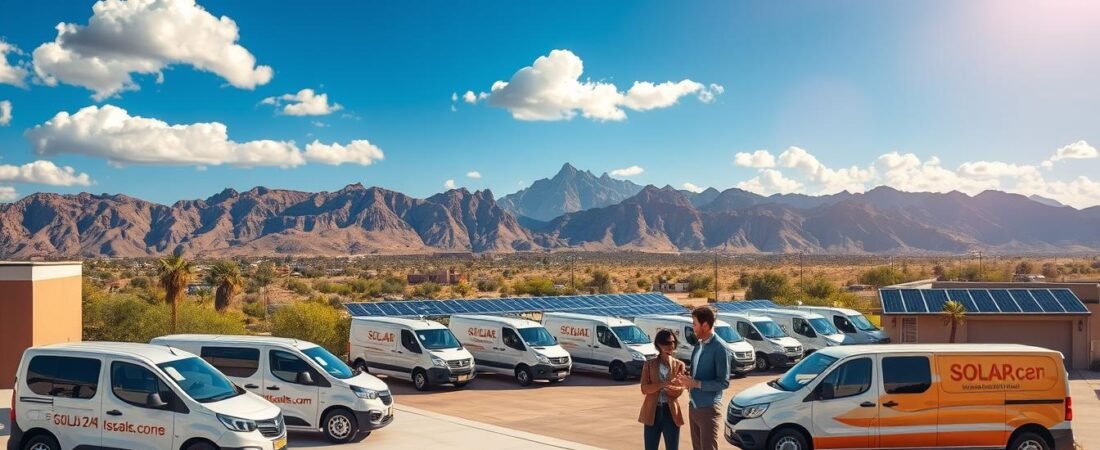
Looking to cut energy bills and pick the right installer? This buyer’s guide gives homeowners a clear, practical path for comparing local options, requesting quotes, and choosing an installer that fits their budget and roof.
What “best” means here is more than price. We focus on equipment quality, warranties, fast service, and honest production estimates. You’ll see how those factors affect long‑term savings and performance.
EcoWatch reports the average Tucson homeowner saves $2,097 per year with solar panels and can expect about $25,000 over 20 years (rankings updated Jan 24, 2025). Those benchmarks frame why many people are shopping now.
This short guide previews the main decision areas—savings, financing options, local incentives, and what the installation process really looks like. It also includes a shortlist of local installers to compare side‑by‑side and a checklist you can use to vet any company.
Use this structure to request multiple quotes, compare terms, and pick the best solar companies for your home and budget.
Why Tucson homeowners are going solar right now
With roughly 6.5 peak sun hours per day, many roofs here produce strong average energy yields when they are unshaded and well-oriented. That daily resource turns into notable yearly output, not just one good day of generation.
What sunshine means for production
Peak sun hours boost midday power and help smaller systems meet more household demand. Production still varies by season; summer days deliver more, winter days less.
Homeowners should look at annual estimates rather than a single bright-day forecast. Yearly numbers capture cloudy days, seasonal shifts, and realistic output that affects savings over years.
How rising electricity rates change the math
Arizona residential rates climbed from 12.5¢/kWh (2021) to 14.9¢/kWh (2024), roughly a 22% rise since 2020. Each increase raises the value of on-site power because every kWh you offset avoids a higher utility charge.
“Predictable generation can shield families from future price spikes and smooth household budgeting.”
Average savings claims depend on usage, system size, export credits, and grid reliance. The stronger the sun and the higher the rates, the more critical it is to pick the right installer and system design for long-term savings.
| Factor | Why it matters | Local data |
|---|---|---|
| Peak sun hours | Drives annual energy production | ~6.5 hours/day |
| Electricity price trend | Increases avoided cost per kWh | 12.5¢ → 14.9¢ (2021–2024) |
| System sizing & export credits | Affects real savings and payback | Depends on usage and net billing rules |
How to choose among solar panel companies in tucson
A simple, score-based approach makes comparisons fast and fair. Rate each installer on five categories: reputation, reviews, warranty, financing clarity, and service breadth. Give 0–5 points per category and total the score to see who truly stands out.
Reputation and certifications to look for
Look for trade credentials and a long track record. BBB listings, NABCEP-style certifications, and several years of documented installs signal reliability. Time-in-business matters when you need support years after install.
Customer reviews, service standards, and complaint history
Read patterns, not single ratings. Check for repeated notes about missed timelines, change orders, or poor communication. Those trends reveal how the installer manages real projects.
Warranties that matter for solar panels and workmanship
Separate manufacturer product/performance warranties (look for ~25 years) from workmanship guarantees (aim for ~10 years). Workmanship terms often determine your long-term peace of mind.
Financing options and pricing transparency
Insist on itemized bids: equipment, labor, roof work, electrical upgrades, monitoring, and permits. Vague line items like “other fees” are a red flag.
Service offerings beyond panel installation
Prefer installers that offer monitoring, maintenance, battery add-ons, and permit support. Post-install service is where top installers prove their value.
Top local solar installers to compare in Tucson
This quick shortlist highlights installers with specific strengths—storage readiness, straightforward installs, or strong maintenance plans—so you can pick the best fit fast.
Technicians for Sustainability
Battery-ready: Tesla Powerwall support, financing help, consultation, battery storage, and full panel installation.
Custom Solar and Leisure
Simple scope: Consultation, financing assistance, and focused panel installation for homeowners wanting a clear, basic install.
Solar Gain
Full-service: Cleaning, permit help, repairs, solar carports, financing, and storage options for long-term upkeep.
The Solar Store LLC
Flexible systems: Grid-tied or off-grid work, repairs, and maintenance that suit varied equipment and usage goals.
Saguaro Solar
Essentials-focused: Reliable installation plus cleaning and maintenance for buyers who prioritize core services.
Clayco Electric & Sunlogix Energy
Storage and support: Battery storage options, repairs, permit assistance, and financing for homeowners aiming at resilience.
Next step: Contact a local solar installer for quotes and an apples-to-apples comparison of price, equipment, and warranty.
Solar panel installation services to confirm before you sign
Before you sign a contract, confirm which site services are written into the scope so there are no surprise costs.
Permits, interconnection, and inspections
Ask who files permits and utility paperwork. Most installers handle permit submittals and interconnection requests, but timelines vary.
Typical steps: permit approval, town/city inspection, then utility interconnection approval. Delays usually come from missing paperwork or inspection backlogs.
Cleaning, maintenance, monitoring, and repair coverage
Get clear promises for monitoring and upkeep. Monitoring should report production data and flag underperformance so issues are found fast.
Confirm whether cleaning, routine checks, and Skilled Repairs are included or sold as options. Tucson dust and monsoon seasons make scheduled upkeep important.
- Pre-sign checklist: written scope, permit handling, interconnection support, inspection coordination, monitoring, cleaning, and repair coverage.
- Who pays what: installer handles permits and most electrical work; homeowner may cover roof fixes, main panel upgrades, or trenching.
- Record keeping: insist every promise appears in the contract and keep copies of all emails, permits, and performance reports.
| Task | Usually by | Notes |
|---|---|---|
| Permit filing | Installer | Timeline: 1–4 weeks |
| Inspection & interconnection | Installer + Utility | Final approval required to operate |
| Roof repairs / panel mounting | Sometimes homeowner | Confirm who pays before work starts |
Pro tip: Ask for sample monitoring reports and a named contact for repairs so you know who to call the day production data shows a problem.
Solar panel system cost in Tucson and what you can save
Upfront price varies widely, so a careful estimate is the first step to real savings. A good quote ties system size, roof work, and sunlight assumptions to a clear price and a realistic payback figure.
What drives your estimate: system size, roof conditions, and sunlight
Major cost drivers are how large a system you need, roof complexity (tile vs shingle, steep pitch), and shading that cuts production. Bigger size raises equipment and labor costs.
Installers may add fees for roof work, electrical upgrades, or difficult access. Two quotes with the same panel count often differ because of equipment tiers and warranty terms.
Typical savings benchmarks and payback expectations
Use known benchmarks to set expectations: average savings about $2,097/year, roughly $25,000 over 20 years, and a typical payback near 8.2 years depending on bills.
How to compare quotes apples-to-apples
Compare price per watt, equipment model numbers, monitoring, and adders like roof work. Ask for a production estimate with azimuth/tilt, shade %, and degradation assumptions.
| Item | What to request | Example note |
|---|---|---|
| Line-item scope | Equipment, labor, permits, roof work | $24,173 total; shows $2.84 price per watt |
| Equipment specs | Model numbers, inverter, warranty | List brand and performance warranty |
| Estimated production | Annual kWh, assumptions (shade/tilt) | Used to calculate savings over years |
| Payment & timeline | Schedule, incentives, state credit shown | Example: $1,000 state incentive applied |
Incentives and policies that change your bottom line in Tucson
Local and state rules can shave thousands off your upfront cost and change how fast a system pays back. Understanding incentives helps you compare true out‑of‑pocket prices and long‑term savings.
Arizona incentives that reduce cost and taxes
State tax credit: Arizona offers a 25% tax credit up to $1,000 for eligible owners. That direct reduction lowers your federal and state math when combined with other credits.
Sales tax exemption: Eligible equipment avoids the state sales tax (5.6%), trimming the purchase price at checkout.
Property tax exemption: Added home value from an installed system is excluded from property tax calculations, so value can rise without raising your property tax bill.
How TEP net billing changes your electricity bill
TEP uses net billing where exported energy gets a credit below retail rates. That makes each exported kWh worth less than the electricity you buy.
Export credits are locked for 10 years once you interconnect. That gives planning certainty, but you should confirm the current export rate before you sign any contract.
Why battery storage can boost savings under net billing
Because export credits are lower than retail, storing midday output for evening use often beats exporting. A battery can reduce your peak grid purchases and shrink your monthly electricity bills.
- Who usually qualifies: Ownership is typically required for state credits and the sales tax exemption.
- Planning tip: Combine incentives, a clear export rate, and a storage strategy to maximize long‑term energy savings.
Equipment choices: solar panels, inverters, and battery storage
Choosing the right equipment shapes production, reliability, and long‑term upkeep costs.
Look beyond count and size. Check wattage, efficiency, and expected yearly degradation on spec sheets. Higher efficiency often yields more energy from limited roof area. Ask how panels behave at high temperature and under shade.
Inverter basics that affect performance
String inverters suit uniform roofs and cost less. Microinverters or optimizers help where shade or multiple roof aspects exist and make troubleshooting easier.
| Type | Best for | Tradeoff |
|---|---|---|
| String | Simple roofs | Lower cost, less panel-level data |
| Microinverters | Shaded or complex roofs | Higher cost, per-module monitoring |
| Optimizers | Mixed orientations | Balance of cost and control |
Battery storage and the federal tax credit
Storage adds resilience and helps manage bills when export credits are lower than retail. The federal battery tax credit is 30% for owned units with ≥3 kWh capacity through 2032.
That credit steps to 26% in 2033, 22% in 2034, and expires in 2035. Leased batteries do not qualify. Claim via IRS Form 5695 and confirm ownership rules before you buy.
Final tip: Confirm compatibility among the battery, inverter, and monitoring platform, and verify full warranty coverage across the full solar panel system. For more on equipment and storage options, see equipment and storage options.
What the solar installation process looks like from quote to power-on
A clear timeline helps you spot delays and know what to expect from quote to final switch‑on. Start by comparing bids line‑by‑line so equipment, labor, and permits match across offers.
Comparing quotes and signing a contract
Ask for model numbers, a production estimate, and a final system design attached to the contract. Confirm payment milestones and change‑order rules so you don’t get surprised.
Site visit, design, and final plan
An installer will measure the roof, check shading, and verify your electrical panel. Those details shape tilt, azimuth, and layout that appear on the final design you sign.
Permits, utility paperwork, and equipment ordering
Permit filing and interconnection paperwork often drive time. Good installers submit documents quickly and order equipment once permits are approved to avoid storage delays.
Installation day: racking, wiring, panels, and inverters
Most installs take about one to three days. Crews mount racking, run conduit and wiring, place panels, and install inverters before commissioning the system.
Inspection and permission to operate
After municipal inspection and utility approval you get permission to operate. Installed hardware may be on your roof for days before you can legally flip the switch. Ask the installer for the expected inspection window and a named contact for follow‑up.
- Quick checklist: itemized quote, signed design, permit status, equipment ETA, installation schedule, inspection timeline.
Contracts, production guarantees, and red flags to avoid
Contracts can hide costs and limits that shrink your expected savings—know what to watch for.
Start by insisting on clarity. Ask for an itemized final price, a firm timeline, and the exact equipment models that will be installed. Vague language often shifts costs to the homeowner later.
Key contract terms to check
- Escalators: These raise lease or PPA payments each year. Know the annual % and how it affects future bills and long‑term savings.
- Change orders: Define what triggers extra charges and require written approval for any scope change.
- Ownership vs. lease/PPA: Owners get tax credits and most incentives; lessees usually do not. Leases may include production guarantees but transfer fewer incentives.
What a real production guarantee should include
A strong guarantee shows the measurement method (metering standard), a performance threshold (for example, 90% of estimated annual output), and clear remedies such as credits or repairs. It should list exclusions like documented shading or roof damage.
Red flags and verification
- Non‑itemized pricing or last‑minute equipment substitutions.
- Pressure to sign the same day or unclear timeline commitments.
- Warranty language that shifts responsibility to you for routine maintenance.
- Unlicensed crews, missing insurance, or an installer who uses unknown subcontractors without disclosure.
| Benchmark | Common industry standard | Why it matters |
|---|---|---|
| Product/performance warranty | 25 years | Protects output and part defects |
| Workmanship warranty | 10 years | Covers installation errors and repairs |
Quick contract checklist: itemized price, model numbers, permit and inspection duties, production guarantee details, escalator terms, who performs the installation, proof of licensing and insurance, and a named contact for post‑install issues.
Conclusion
The best results come from matching the right equipment and installer to your roof, usage, and budget—not from chasing the lowest advertised price.
Collect multiple itemized quotes and compare model numbers, warranties, and permit or interconnection support. Ask each installer for a clear production estimate and written scope so you can judge long‑term performance and savings.
Remember: incentives, net billing rules, and battery options can shift the value of a solar panel system. Factor those items into any apples‑to‑apples comparison before choosing.
Use the red‑flag checklist: unclear fees, escalation clauses, vague change‑order rules, or missing insurance. Shortlist a few local companies, request verified production data, and pick the offer that best protects your long‑term energy and financial goals.