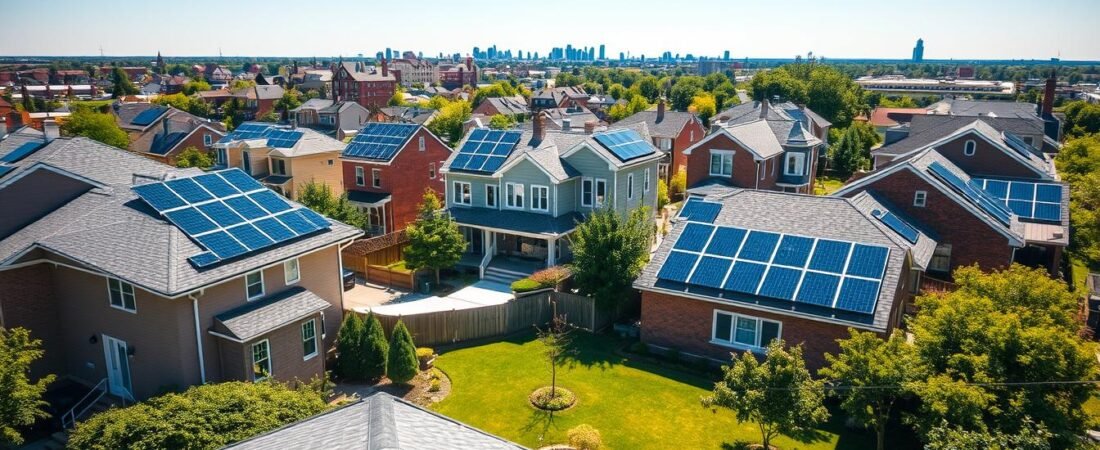
Understanding the true price means looking past sticker tags. Homeowners should know that “solar panel cost baltimore” typically covers equipment, labor, permitting and interconnection fees. These line items shape the total expense and affect long‑term value.
Expect a significant upfront purchase, but it can convert years of electricity bills into steady, predictable spending. Prices change with system size, roof type, equipment tier and financing method.
Local rules matter. Baltimore Gas and Electric (BGE) policies, Maryland net metering, and state incentives and tax credits often lower the final price. That makes direct comparisons essential when you shop.
By the end of this guide, you will know typical system pricing, which incentives reduce what you pay, and how to evaluate savings using $/W and payback timelines. Use that info to request quotes and pick the best option for your home and budget.
What Baltimore homeowners can expect to pay for solar in 2026
Homeowners should focus on the $/W number to make sense of varied proposals. The installed price per watt normalizes quotes so you can compare different system sizes and warranties quickly.
Maryland benchmark and a real example
As of Feb 2026 the average installed price is about $2.64 per watt in Maryland. For a typical 14.42 kW system that converts to roughly $38,026 before incentives.
Low-to-high range and quick sanity check
Expect a typical range of $32,322–$43,730. Use these thresholds to judge quotes:
- Good price: $32,322 or less
- Market average: $38,026
- High price: $43,730 or more
| Metric | Value | Why it matters |
|---|---|---|
| Installed per watt | $2.64/W | Quick apples-to-apples comparison |
| Typical system size | 14.42 kW | Represents average Maryland home usage |
| Pre-incentive range | $32,322–$43,730 | Shows normal market spread |
Different datasets and installers may list slightly different prices, so quotes—not averages—define your true installation costs. Think of this as a long-term solar investment: upfront numbers matter, but incentives, net metering, and bill offset shape the final return.
Solar panel cost baltimore by system size and home energy needs
Estimate how many kilowatt‑hours your home uses each month, then pick a system size that meets that need. This keeps sizing practical and helps avoid paying for more capacity than you’ll use.
Typical Maryland system price examples (3–10 kW)
Use this quick ladder to ballpark what a solar system may run before incentives:
- 3 kW — $7,912
- 4 kW — $10,549
- 5 kW — $13,186
- 6 kW — $15,823
- 7 kW — $18,460
- 8 kW — $21,097
- 9 kW — $23,735
- 10 kW — $26,372
Translate electricity use into the right size
A rough rule: 1 kW of capacity typically produces about 100–140 kWh per month in many U.S. locations. Use your monthly kWh to pick a target size for a 60%, 80%, or 100% offset. For example, a household using 900 kWh monthly might aim for 6–9 kW depending on the offset goal.
How size changes total price vs $/W
Total system cost rises with size, but the price per watt can improve if installation complexity stays low. Conversely, a complex roof raises both total price and $/W.
If you plan to add an EV or heat pump, sizing a bit larger makes long‑term sense. If budget caps you today, a slightly smaller system still gives immediate savings and room to expand later.
Want a local quote? Compare installers and details at Palmetto’s Baltimore page to find systems that match your home and goals.
What drives solar installation costs in Baltimore beyond the sticker price
Beyond headline numbers, many on‑site and gear decisions drive what you’ll really pay. Understanding these drivers helps you compare offers and avoid surprises.
Roof factors that matter
Shading changes design and output. Heavy shade may force more complex layouts or fewer usable panels, raising labor and per‑watt costs.
Pitch and condition affect safety and time on the roof. Steeper slopes or an old roof add labor and may require a roof repair before installation costs are final.
Usable area limits system size. Small or fragmented roof space can increase mounts and wiring runs, which raises overall installation costs.
Equipment and installation variables
Choosing standard vs premium panels, string inverters vs microinverters, and add‑ons like monitoring changes price and performance. Check equipment specs and warranties closely.
Quotes differ when electrical upgrades, conduit runs, attic access, or structural work are needed. Permitting, BGE interconnection steps (design, application, inspection, net meter, permission to operate) also affect the timeline and final costs.
How to compare quotes
Compare apples to apples by checking $/W, exact equipment model numbers, warranties, production estimates, and project timeline. Also vet the company’s experience and documentation to avoid change orders later.
Incentives and credits that reduce solar costs in Baltimore and Maryland
Several Maryland programs and county credits make going renewable much cheaper for homeowners. Below are the most meaningful incentives that reduce out‑of‑pocket price and boost project value.
Sales tax exemption
Automatic 6% exemption removes the state sales tax on eligible equipment. That lowers the upfront price at purchase and shows up directly on installer invoices.
Property tax protection
Maryland offers a 100% property tax exemption for added assessed value from a renewable system. In plain terms, your home can gain value without increasing your property tax bill.
SRECs and performance payments
SRECs pay for production: you earn one credit per 1,000 kWh (1 MWh). Recent market values range near $50–$55 per credit, with the SACP set at $55 for 2025 and scheduled to decline through 2030.
MSAP grant
The Maryland Solar Access Program (MSAP) offers up to $750 per kW, capped at $7,500, for eligible low/moderate‑income owner‑occupied homes. FY2026 ran on a reservation + completion model and funds are first‑come, first‑served.
Baltimore County credit and federal notes
Baltimore County may offer a property tax credit equal to 50% of installation costs, up to $5,000 where applicable. Local rules vary, so confirm eligibility with your county.
Note: A federal tax credit still exists in many ownership scenarios and can further reduce net expense, but state programs above are the most predictable savings for Maryland homeowners.
Net metering and utility rules: how BGE affects your solar savings
How your meter credits and yearly settlement work can change the return you actually see from a rooftop system. In Maryland, net metering gives retail‑rate credits when your system exports more power than you use. Those credits roll forward so you can bank summer generation for winter use.
Annual rollover and the April true‑up
Credits accumulate month to month and then undergo an annual true‑up in April. Any leftover credits at that time may be cashed out at a lower rate instead of retained on your bill.
BGE payout details
BGE purchases excess generation at the Standard Offer‑of‑Service rate — roughly $0.10/kWh. That is often below retail, so exported power can be worth less in cash than in bill credits.
Why your supplier choice matters
Maryland has a deregulated electricity market. Your retail supplier rate affects the dollar value of credits and overall savings. Ask installers to model savings using your actual utility bill and current supplier rate.
“Have your installer run savings with your BGE bill history so projections match reality.”
| Rule | What it means | Practical tip |
|---|---|---|
| Net metering | Exports create retail credits | Maximize self‑consumption to boost value |
| April true‑up | Yearly settlement of leftover credits | Avoid large annual waivers by timing usage |
| BGE payout | Paid ~ $0.10/kWh for excess | Use or store generation rather than export |
How much can solar save in Baltimore over time?
A realistic savings estimate comes from comparing your historic bills with the installer’s yearly production forecast.
25-year savings and why results vary
Maryland benchmark: a typical homeowner could see roughly $75,628 in avoided electricity spending over 25 years after incentives. That number is a useful yardstick, not a promise.
Why it changes: roof orientation, shading, local utility rules, and how you finance the system all change outcomes. Smaller roofs or heavy shade cut production; cheaper financing raises net savings.
Payback period explained
The average payback in Maryland is about 9.84 years. Payback means years until the saved electricity equals your upfront outlay, not total profit.
After payback, most years are net benefit: savings grow as electricity rates rise and maintenance stays low.
Why rising electricity prices matter
Maryland rates rose about 37% from 2020 to 2024. Higher rates make a solar investment more valuable because each kWh avoided is worth more in dollars.
“Compare the installer’s annual production to your past kWh use and check the assumed escalation rate — that’s your sanity check.”
- How savings are calculated: avoided electricity purchases minus system cost, adjusted for incentives and rate escalation.
- Sanity checks: match quoted yearly kWh to your last 12 months of bills and confirm the escalation assumption is reasonable.
- Bottom line: much solar value depends on utility rules, your usage patterns, and whether the system offsets the right share of your bill.
Buying vs financing solar in Baltimore: cash, loan, lease, and PPA options
Choosing how to pay for a rooftop system changes monthly bills and long‑term returns. Below are clear options and the tradeoffs to weigh.
Cash purchase vs loan
Paying cash gives the best long‑term return because you avoid interest and usually keep the full tax credit benefit.
Loans spread the price over years. Interest rate and term can cut into savings, so compare APR and total paid before signing.
$0‑down financing
Some providers offer $0‑down plans. If the monthly loan payment is below your current electric bill, you can reduce monthly spending immediately while owning the system.
Leases and PPAs
Leases and PPAs lower upfront needs because a third party owns the system. They can deliver near‑term savings, but read escalators, buyout rules, and production guarantees carefully.
Battery storage add‑ons
Storage adds resilience and time‑shifting. Maryland’s RCES grants can cover up to the lesser of 30% of installed storage or $5,000 (applications open through June 5, 2026, or until funds run out).
“Ask who receives the tax credit and how a sale or move affects the agreement.”
| Option | Who owns | Key benefit | Watch for |
|---|---|---|---|
| Cash | Homeowner | Max long‑term savings, full tax credit | High upfront payment |
| Loan | Homeowner | Own now, pay over time | Interest reduces net savings |
| Lease/PPA | Provider | Low/no upfront, immediate savings possible | Escalators, buyout terms, no tax credit to homeowner |
Checklist before signing: total price, payment schedule, warranty, monitoring access, and sale/transfer terms. Confirm who claims the federal tax credit and other incentives.
How to get the best solar panel price in Baltimore
Collecting quotes from different installers reveals the true range of offers. Getting multiple bids often drives competition and can lower prices by up to 20% compared with using a single company.
Why multiple quotes matter
Multiple proposals expose assumptions and let you compare an apples‑to‑apples price per watt and total system price. Installers vary on equipment, labor, and which incentives they apply.
Key items to compare
- $/W and total price: normalize bids to cost per watt and check the overall spend.
- Equipment specs: list model numbers for modules, inverters, and racking.
- Warranties & production: written guarantees on output and workmanship.
- Timeline & permits: clear schedule plus who handles interconnection and inspections.
How to validate production estimates
Ask how shading, tilt, and orientation were modeled. Compare the quoted annual kWh to your past 12 months of usage to see if the proposed system size aligns with your needs.
Red flags that inflate prices
- Oversized systems pushed to increase the invoice.
- Vague “premium” language without model numbers.
- Missing written incentives, tax credit handling, or permitting details.
“Shortlist two or three companies, ask the same questions, and request an apples‑to‑apples revision when proposals differ in scope.”
Action plan: collect 3 quotes, compare $/W, equipment, warranties, and incentives, then negotiate or request a revised bid that matches the lowest scope before you sign.
Conclusion
,
Good decisions come from clear numbers: compare the installed $/W (Maryland benchmark ≈ $2.64/W) with the installer’s annual production and equipment list.
Incentives matter. State sales and property tax exemptions, SRECs, and MSAP grants can cut net price substantially for eligible owners.
Remember utility rules: BGE pays roughly $0.10/kWh for excess, so modeling exports vs self‑consumption changes projected savings.
Next step: gather multiple quotes, normalize to $/W and annual kWh, and confirm all incentives and documentation before signing.
Bottom line: you don’t need to memorize every detail—ask for transparent numbers, written specs, and realistic production estimates to make a confident home energy decision.
FAQ
How much do solar panels cost in Baltimore?
What can Baltimore homeowners expect to pay for systems in 2026?
What does an average installed price per watt mean for my home?
How do costs differ by system size and household energy use?
How can I estimate the ideal system size from my electricity usage?
How does system size affect total price versus price per watt?
What roof factors change installation expenses?
Which equipment choices most influence price?
What permitting or electrical work can add to the bill?
Why do installer quotes vary so much and how do I compare them?
What state incentives can reduce my upfront price?
Are there local Baltimore or county incentives I should know about?
How does net metering work in Maryland and with BGE?
FAQ
How much do solar panels cost in Baltimore?
Prices vary, but using Maryland averages for early 2026 gives a useful benchmark. The typical installed price is about .64 per watt, which works out to roughly ,026 before incentives for a 14.42 kW system that fits many area homes. Final outlay depends on system size, equipment choices, and site-specific work like roof repairs or electrical upgrades.
What can Baltimore homeowners expect to pay for systems in 2026?
Expect a range: some quotes fall below the market average for well-priced equipment and simple installs, while high-end offers include premium modules, advanced inverters, or extensive roof work. Comparing the $/W, warranties, and production estimates helps you spot a fair offer versus a high one.
What does an average installed price per watt mean for my home?
Multiply the per-watt figure by the system size you need. For example, at .64/W a 10 kW array would be about ,400 before incentives. That gives a quick way to estimate before getting a site visit and a precise quote.
How do costs differ by system size and household energy use?
Smaller systems (3 kW) have higher per-watt costs but lower total spend; larger systems (8–10 kW) usually lower the $/W and raise total investment. Choose a size based on your annual kWh use and the percentage of electricity you want to offset. Your utility bills and a production estimate from an installer guide that decision.
How can I estimate the ideal system size from my electricity usage?
Check 12 months of utility bills for total kWh used. Divide desired annual offset by expected production per kW in Maryland (roughly 1,100–1,300 kWh per kW-year, depending on roof orientation and shading). That gives the kW capacity to target before factoring in future usage growth.
How does system size affect total price versus price per watt?
Total price scales with capacity, but cost per watt typically drops as systems grow because fixed labor and permit costs spread across more modules. However, site complications can offset those savings.
What roof factors change installation expenses?
Shading, steep pitch, poor roof condition, and limited usable area raise labor and design time. A simple south-facing asphalt roof with minimal shading usually yields the lowest install charges.
Which equipment choices most influence price?
Module brand and efficiency, inverter type (string vs. microinverters), racking quality, and monitoring or optimizer add-ons all affect price. Higher-efficiency panels cost more but reduce roof area needed.
What permitting or electrical work can add to the bill?
Local permits, interconnection fees, required electrical panel upgrades, and inspections can add several hundred to a few thousand dollars. Remote site access or extended trenching for wiring also increases costs.
Why do installer quotes vary so much and how do I compare them?
Variations come from equipment choices, workmanship, overhead, and how conservatively a company estimates production. Compare apples-to-apples: $/W, module and inverter models, performance warranties, production estimates, expected timeline, and included services.
What state incentives can reduce my upfront price?
Maryland offers a sales tax exemption on eligible equipment and a property tax exemption so added home value won’t raise your taxes. There are also SRECs that pay for generation and programs like MSAP offering up to 0 per kW (max ,500) for qualifying homeowners.
Are there local Baltimore or county incentives I should know about?
Some local programs exist, such as Baltimore County’s property tax credit in certain cases that can cover a portion of costs (caps apply). Check with your county and city for current credits and eligibility rules.
How does net metering work in Maryland and with BGE?
Maryland supports retail-rate net metering with rollover credits and an April true-up. For excess generation, BGE buys the surplus at the Standard Offer-of-Service rate (around
FAQ
How much do solar panels cost in Baltimore?
Prices vary, but using Maryland averages for early 2026 gives a useful benchmark. The typical installed price is about $2.64 per watt, which works out to roughly $38,026 before incentives for a 14.42 kW system that fits many area homes. Final outlay depends on system size, equipment choices, and site-specific work like roof repairs or electrical upgrades.
What can Baltimore homeowners expect to pay for systems in 2026?
Expect a range: some quotes fall below the market average for well-priced equipment and simple installs, while high-end offers include premium modules, advanced inverters, or extensive roof work. Comparing the $/W, warranties, and production estimates helps you spot a fair offer versus a high one.
What does an average installed price per watt mean for my home?
Multiply the per-watt figure by the system size you need. For example, at $2.64/W a 10 kW array would be about $26,400 before incentives. That gives a quick way to estimate before getting a site visit and a precise quote.
How do costs differ by system size and household energy use?
Smaller systems (3 kW) have higher per-watt costs but lower total spend; larger systems (8–10 kW) usually lower the $/W and raise total investment. Choose a size based on your annual kWh use and the percentage of electricity you want to offset. Your utility bills and a production estimate from an installer guide that decision.
How can I estimate the ideal system size from my electricity usage?
Check 12 months of utility bills for total kWh used. Divide desired annual offset by expected production per kW in Maryland (roughly 1,100–1,300 kWh per kW-year, depending on roof orientation and shading). That gives the kW capacity to target before factoring in future usage growth.
How does system size affect total price versus price per watt?
Total price scales with capacity, but cost per watt typically drops as systems grow because fixed labor and permit costs spread across more modules. However, site complications can offset those savings.
What roof factors change installation expenses?
Shading, steep pitch, poor roof condition, and limited usable area raise labor and design time. A simple south-facing asphalt roof with minimal shading usually yields the lowest install charges.
Which equipment choices most influence price?
Module brand and efficiency, inverter type (string vs. microinverters), racking quality, and monitoring or optimizer add-ons all affect price. Higher-efficiency panels cost more but reduce roof area needed.
What permitting or electrical work can add to the bill?
Local permits, interconnection fees, required electrical panel upgrades, and inspections can add several hundred to a few thousand dollars. Remote site access or extended trenching for wiring also increases costs.
Why do installer quotes vary so much and how do I compare them?
Variations come from equipment choices, workmanship, overhead, and how conservatively a company estimates production. Compare apples-to-apples: $/W, module and inverter models, performance warranties, production estimates, expected timeline, and included services.
What state incentives can reduce my upfront price?
Maryland offers a sales tax exemption on eligible equipment and a property tax exemption so added home value won’t raise your taxes. There are also SRECs that pay for generation and programs like MSAP offering up to $750 per kW (max $7,500) for qualifying homeowners.
Are there local Baltimore or county incentives I should know about?
Some local programs exist, such as Baltimore County’s property tax credit in certain cases that can cover a portion of costs (caps apply). Check with your county and city for current credits and eligibility rules.
How does net metering work in Maryland and with BGE?
Maryland supports retail-rate net metering with rollover credits and an April true-up. For excess generation, BGE buys the surplus at the Standard Offer-of-Service rate (around $0.10/kWh), so production timing and your retail supplier choice affect value.
Can my choice of retail electricity supplier change solar value?
Yes. If you switch from BGE’s default to an alternative supplier with different rates, the retail value of your avoided purchases and the economics of net metering can shift. Factor supplier rates into savings estimates.
How much can a system save over 25 years in Maryland?
Using current averages, lifetime savings estimates center near $75,600 over 25 years, but actual savings vary with system size, production, future electricity rates, and incentives. Higher retail rates increase long-term benefits.
What payback period should I expect?
Payback typically runs around 9.8 years in Maryland averages, depending on upfront price, incentives claimed, and how much of your usage the system offsets.
How do rising utility rates affect the financial case?
When electricity prices rise, the value of generated energy increases. Maryland’s rates rose roughly 37% from 2020 to 2024, which boosts future savings and shortens payback compared with a flat-rate scenario.
Should I buy, loan, lease, or choose a PPA?
Cash purchase yields the strongest long-term savings. Loans can preserve cash while keeping incentives if structured right. Leases and PPAs lower upfront cost but give smaller long-term gains because a third party owns the system. Compare total returns, contract terms, and who claims tax incentives.
How does financing change long-term savings?
Interest on loans reduces net savings versus a cash buy, but low-rate or 0% options can still beat utility bills immediately. Run numbers with the loan APR, term, and predicted production to compare to cash purchase.
Are there incentives for battery storage in Maryland?
Yes. Programs like the Residential Clean Energy Grant (RCES) offer grants up to $5,000 for qualifying residential storage installations, improving backup and self-consumption economics.
How do I get the best price on a system?
Solicit multiple competitive quotes—getting several bids often lowers prices by up to 20%. Ask for itemized proposals, confirm equipment models, and request production estimates based on your roof. Use local reviews and verify licensing and insurance.
What key items should I compare across quotes?
Compare $/W, panel and inverter models, production guarantees, workmanship and equipment warranties, timeline, and whether permits and incentives are handled. An installer that provides a clear, itemized contract makes comparisons easier.
What are red flags that could increase my final price?
Watch for vague production claims, oversized systems pushed to increase profit, missing incentive paperwork, or unclear warranty terms. Also be wary of very low bids that skip permitting or use outdated equipment models.
.10/kWh), so production timing and your retail supplier choice affect value.
Can my choice of retail electricity supplier change solar value?
Yes. If you switch from BGE’s default to an alternative supplier with different rates, the retail value of your avoided purchases and the economics of net metering can shift. Factor supplier rates into savings estimates.
How much can a system save over 25 years in Maryland?
Using current averages, lifetime savings estimates center near ,600 over 25 years, but actual savings vary with system size, production, future electricity rates, and incentives. Higher retail rates increase long-term benefits.
What payback period should I expect?
Payback typically runs around 9.8 years in Maryland averages, depending on upfront price, incentives claimed, and how much of your usage the system offsets.
How do rising utility rates affect the financial case?
When electricity prices rise, the value of generated energy increases. Maryland’s rates rose roughly 37% from 2020 to 2024, which boosts future savings and shortens payback compared with a flat-rate scenario.
Should I buy, loan, lease, or choose a PPA?
Cash purchase yields the strongest long-term savings. Loans can preserve cash while keeping incentives if structured right. Leases and PPAs lower upfront cost but give smaller long-term gains because a third party owns the system. Compare total returns, contract terms, and who claims tax incentives.
How does financing change long-term savings?
Interest on loans reduces net savings versus a cash buy, but low-rate or 0% options can still beat utility bills immediately. Run numbers with the loan APR, term, and predicted production to compare to cash purchase.
Are there incentives for battery storage in Maryland?
Yes. Programs like the Residential Clean Energy Grant (RCES) offer grants up to ,000 for qualifying residential storage installations, improving backup and self-consumption economics.
How do I get the best price on a system?
Solicit multiple competitive quotes—getting several bids often lowers prices by up to 20%. Ask for itemized proposals, confirm equipment models, and request production estimates based on your roof. Use local reviews and verify licensing and insurance.
What key items should I compare across quotes?
Compare $/W, panel and inverter models, production guarantees, workmanship and equipment warranties, timeline, and whether permits and incentives are handled. An installer that provides a clear, itemized contract makes comparisons easier.
What are red flags that could increase my final price?
Watch for vague production claims, oversized systems pushed to increase profit, missing incentive paperwork, or unclear warranty terms. Also be wary of very low bids that skip permitting or use outdated equipment models.