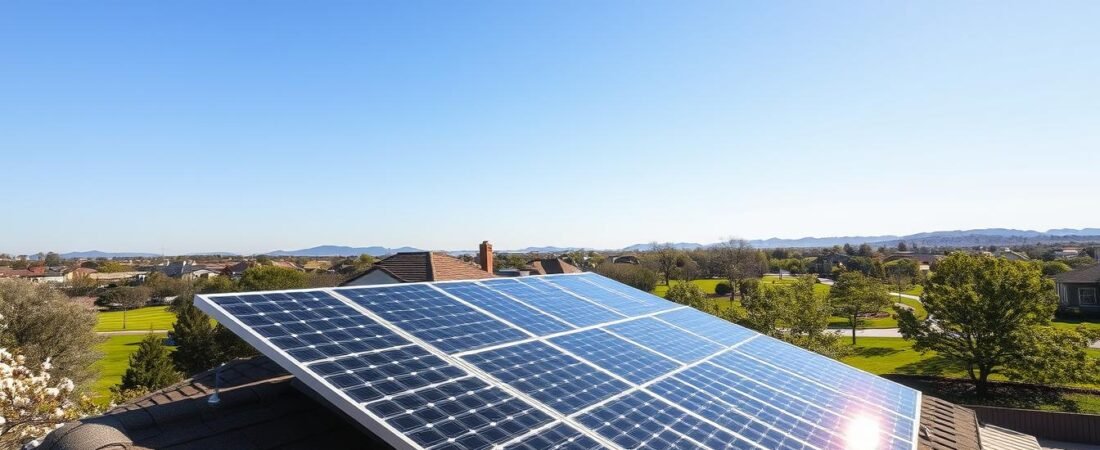
Here’s what Round Rock homeowners typically see in 2026: the local installed benchmark sits at $2.19/W, with an average system size near 13.71 kW and a typical pre-incentive total of about $30,083.
Sticker price tells part of the story. Buyback credits, incentives, and financing change the net value for a home owner. This guide helps you compare quotes and pick a system that fits your budget.
Texas electricity rates rose from 12.1¢/kWh in 2021 to 14.9¢/kWh in 2024, near a 23% increase. That rise shows why many consider on-site generation to reduce long-term exposure to higher utility bills.
What you’ll learn: price benchmarks, size-based totals, main drivers like roof and equipment, local utility buyback rules, tax benefits, payback estimates, financing options, and how to vet installers so you don’t overpay.
Round Rock solar panel prices right now: 2026 benchmarks
Before you call installers, lock in three local benchmark figures. Knowing the average $/W, a typical total, and the local spread helps you spot outlier bids quickly.
Key local numbers to memorize
- Average installed price: $2.19 per watt (Feb 2026).
- Typical total for a 13.71 kW home system: about $30,083 before incentives.
- Realistic range: approximately $25,571–$34,595 for that system size.
What bids mean
A bid at $25,571 or less is considered a good price. Around $30,083 is the market average. Bids at $34,595 or higher are in the high band.
Totals shift with roof complexity, electrical upgrades, and equipment choices. Aim for a fair $/W for your home, not just the lowest headline number.
How to use this section: Bring these benchmarks to every consultation and ask the rep to explain any gap versus the market average.
Solar panel cost round rock by system size
Work out a fair $/W first — it makes every quote comparable.
Why $/W matters: dollars per watt normalize offers across different system sizes and panel counts. That metric shows whether an installer’s pricing is genuinely competitive.
Installed estimates (3–10 kW)
- 3 kW — $6,582
- 4 kW — $8,777
- 5 kW — $10,971
- 6 kW — $13,165
- 7 kW — $15,359
- 8 kW — $17,553
- 9 kW — $19,747
- 10 kW — $21,941
Sizing to your usage
Review 12 months of household kWh to match a system to your electricity needs. Decide the percent of your bill you want to offset and include future loads like an EV or a heat pump.
Production timing matters. If most use happens at night, a larger system or storage may be needed to maximize savings under local buyback rules.
5 kW vs 10 kW: real examples
A 5 kW install at $10,971 reduces bills for an average household. Doubling to 10 kW (~$21,941) roughly doubles production and coverage, assuming roof space and interconnection allow it.
Ask installers for annual kWh estimates plus assumptions on orientation, shading, and degradation — not just panel counts.
What drives your total solar installation cost in Round Rock
Several site-specific factors explain why two bids for the same-sized system can differ by thousands.
Roof factors that change pricing
Your roof condition matters. If shingles need replacing, installers will add labor and materials or delay work until repairs finish.
Steep pitch, many roof planes, and limited usable space raise labor time and hardware needs. Heavy shading can force panel placement on fewer rafters or require extra racking.
Texas guidance favors angles between 15–40° for good output, so unusual pitches may need custom mounts that increase the price.
Equipment choices and add-ons
Higher-efficiency modules and microinverters cost more up front but can boost output in tight spaces.
Batteries add significant expense for backup or time-shifting, while premium inverters, monitoring, and extended warranties raise the initial figure but cut long‑term hassle.
Electric and permitting scope
Main service upgrades, meter or interconnection work, and local permits vary by home. These items affect labor and schedule and explain many higher bids.
Tip: Ask for an itemized proposal and compare base installation vs. line-item adders and then review local benchmark data at local benchmark data.
Utility buyback programs in Round Rock: what replaces traditional net metering
Understanding how your utility buys back excess generation changes the math on payback and system design.
Many homeowners in the area do not get traditional net metering. Instead, local utility programs set specific credit rules. That makes a big difference in savings estimates.
Austin Energy — Buy‑All, Sell‑All Value of Solar
Austin Energy buys all generation at the Value of Solar rate (about $0.0991/kWh) while you buy consumption at retail prices. Credits roll over monthly but any remaining credit is forfeited each December.
Pedernales Electric Cooperative — net billing
PEC uses net billing. On‑site use offsets retail purchases immediately. Exports get a lower credit (around $0.06/kWh) and settlements happen monthly with no annual true‑up.
Why self‑consumption often wins
Because export credits are lower than retail, using generated power at the time of production usually gives the biggest savings. That affects placement, inverter choice, and whether adding storage is worth it.
Tip: Ask installers for a savings model tied to Austin Energy or PEC rates, not a generic net metering assumption.
| Utility | Credit Type | Typical Export Credit | Rollover/True‑up |
|---|---|---|---|
| Austin Energy | Buy‑All, Sell‑All | $0.0991/kWh | Monthly rollover; forfeited in December |
| Pedernales Electric Co‑op | Net billing | ≈ $0.06/kWh | Monthly settlement; no annual true‑up |
Solar incentives and tax benefits that can lower (or protect) your investment
A key incentive in Texas shields homeowners from a property-tax increase after installation. TX Tax Code Section 11.27 gives a 100% exemption for the added value a qualifying system brings to your home.
This matters because typical systems can add about $15,000–$25,000 to a home’s market value. With the exemption, that increase is not counted in your property-tax assessment.
How much you can save
If added value runs $15,000–$25,000, expect roughly $400–$600 per year in avoided property tax. Over a system lifetime, that can top four or five figures and helps protect your overall investment.
Who qualifies and how to claim
Eligibility requires ownership (not a lease) and that the system primarily serves on-site energy use. To claim the exemption, file Form 50-123 with your county appraisal district by April 30.
Buyer tip: Ask your installer for the paperwork they provide and whether they will supply system specs and proof of ownership to include with your filing.
Solar access protections and HOAs
Texas law prevents HOAs and municipalities from banning systems outright. They may set reasonable placement rules, but not unreasonably restrict installation.
| Feature | What it means | Action for homeowners |
|---|---|---|
| TX Tax Code 11.27 | 100% exemption on added property value | File Form 50-123 by April 30 |
| Estimated value added | $15,000–$25,000 | Expect ≈ $400–$600/yr tax savings |
| Eligibility | Owned system, primarily on-site use | Confirm ownership and collect installer documentation |
| HOA protections | No outright bans; reasonable restrictions allowed | Review HOA rules early and document approvals |
Is solar worth it in Round Rock? Payback period, savings, and rate trends
For many homeowners here, payback shows up in under a decade when numbers align.
Local expectations
Payback period: recent quote data indicates about 7.54 years. That means monthly bill reductions typically cover loan payments or recover the upfront spend in under eight years.
Long‑term upside
Savings: marketplace estimates suggest up to about $89,107 over 25 years, depending on system price, export credits, and how much generated energy you use directly.
Why rates and sun matter
Texas electricity rates rose from 12.1¢/kWh (2021) to 14.9¢/kWh (2024), an ~23% jump. Rising rates increase the value of each kWh your system produces.
Round Rock averages about 5.4 peak sun hours per day and 220+ sunny days, which supports steady annual production.
| Metric | Typical value | Effect on payback |
|---|---|---|
| Payback period | ~7.54 years | Shorter with high self‑use |
| 25‑year savings | Up to $89,107 | Depends on rates & export credits |
| Peak sun | 5.4 hrs/day; 220+ days | Supports consistent production |
| Rate trend | +23% (2021–2024) | Improves long‑term value |
What stretches the payback period? High upfront pricing, low export credits, shading, financing interest, or adding batteries. What improves it? Competitive quotes, good roof exposure, and higher self‑consumption.
Tip: Ask for a proposal that shows both payback period and cash‑flow projections so you can compare real monthly savings versus payments.
How to pay for solar panels in Round Rock: cash, loan, lease, or PPA
Choosing how to pay matters as much as choosing equipment—your method affects monthly bills, ownership, and lifetime savings.
Cash purchase
Cash gives the highest long-term savings and full ownership. You keep tax benefits and the Texas property-tax exemption that requires ownership. Upfront spend is larger, but no interest reduces lifetime return.
Loans
Loans, including $0-down options, let you avoid big upfront payments. Watch APR, fees, and loan term carefully. Interest reduces total savings even when monthly payments feel low.
Leases and PPAs
Leases usually mean a fixed monthly payment and provider maintenance. PPAs charge per kWh produced, so bills vary by season. Both limit ownership benefits and may affect eligibility for tax breaks.
Local lease example & decision tips
Palmetto LightReach offers payments as low as $89/month and typical ~ $125/month for a ~9.72 kW system. Providers often include monitoring and a 90% production guarantee.
Decision tip: Choose cash to maximize long-term savings, a loan to spread payments, or a lease/PPA to minimize upfront outlay. Match your choice to how much time you expect to stay in the home.
How to choose a solar company in Round Rock and compare quotes confidently
Getting three clear bids is the fastest way to spot a fair offer and avoid surprises. Comparing proposals can shave up to 20% off the final price, per marketplace data. That difference shows why quote shopping matters.
What to check in every proposal
Use a simple scorecard so you compare apples to apples. Look for installed $/W, total system size (kW), expected annual production (kWh), and the assumptions behind that production.
| Item | Why it matters |
|---|---|
| Installed $/W | Normalize price across offers |
| Production estimate | Check assumptions on shade and orientation |
| Warranties & monitoring | Protect long‑term performance |
How to spot quote traps and service red flags
Watch for big adders, vague production claims, or missing permit/interconnection line items. Be skeptical if savings assume traditional net metering when your utility uses buyback rules.
Ask who handles warranty claims, typical response times, and whether there’s a performance guarantee. Confirm monitoring is included and if there are ongoing fees.
Start your list with installers to research: Atma Energy, Texas Solar Professional, IntegrateSun, Palmetto, and Alba Energy. Verify license, insurance, reviews, and local installations before you sign.
“Request apples‑to‑apples bids using the same assumptions so you can compare companies on transparency, not just on a headline price.”
Conclusion
A concise comparison of offers and utility rules will reveal the best path for your home.
Remember the key local numbers: about $2.19/W and roughly $30,083 for a 13.71 kW system before incentives. Reported payback sits near 7.54 years, with possible 25‑year savings up to $89,107.
Utility details matter: Austin Energy pays ≈ $0.0991/kWh with monthly rollover (credits forfeited in December). PEC uses net billing with exports near ≈ $0.06/kWh. Those rules reward smart self‑consumption.
Take action: gather 2–4 quotes, compare installed $/W and production assumptions, pick a payment route that fits your budget, and file Form 50‑123 by April 30 to claim the TX tax exemption for owned systems.
Round Rock gets about 5.4 peak sun hours and 220+ sunny days — one afternoon of homework can protect your energy bills for years.
FAQ
What are current installed prices in Round Rock for a typical home system?
How do “good,” “market average,” and “high” pricing tiers differ in local quote data?
Why does cost per watt matter when comparing proposals?
What are estimated installed prices for common system sizes in Round Rock?
How do I choose the right system size for my usage and bill goals?
What cost difference should I expect between a 5 kW and a 10 kW system locally?
What roof factors most affect installation pricing?
How do equipment choices change the final price?
What electrical and permit costs should I plan for?
How do Round Rock buyback programs work compared with old net metering?
What about Pedernales Electric Cooperative’s export credits?
Why does consuming power at the home increase savings under these programs?
What state incentives protect or reduce the investment in Texas?
How much can the property-tax exemption be worth?
How do I claim the Texas property-tax exemption for my system?
What protections does Texas law offer regarding HOAs and panel placement?
What payback period can Round Rock homeowners expect?
What are typical long-term savings over 25 years?
How important are future electricity rate increases to the value proposition?
What solar production can Round Rock expect?
What financing options are available for homeowners?
FAQ
What are current installed prices in Round Rock for a typical home system?
The latest benchmark (February 2026) shows an average installed price near .19 per watt in Round Rock. For the average 13.71 kW home setup that translates to about ,083 before incentives. Local quotes will vary by equipment, roof complexity, and installer.
How do “good,” “market average,” and “high” pricing tiers differ in local quote data?
“Good” offers tend to come from competitive bids with efficient designs and mid-to-high quality modules, producing a lower $/W. Market average reflects typical proposals from reputable installers. High pricing usually includes premium panels, complex roof work, or smaller install volumes. Comparing $/W, production estimates, and warranties helps spot value.
Why does cost per watt matter when comparing proposals?
Cost per watt standardizes prices across system sizes so you can compare apples to apples. It shows how much you pay for each watt of capacity, but you should also check modeled annual energy production and shading reports to ensure real value.
What are estimated installed prices for common system sizes in Round Rock?
Smaller residential systems (3–5 kW) usually have a higher $/W than larger systems due to fixed labor and permit costs. Mid-size systems (6–8 kW) hit closer to market average, and 9–13 kW systems often deliver the best $/W. Exact figures depend on component choices and roof conditions.
How do I choose the right system size for my usage and bill goals?
Match annual production to your electricity use. Review recent utility bills for kWh per month, consider future changes (EVs, heat pumps), and aim for a system that offsets your target percentage of consumption. Installers can model production using Round Rock’s average peak sun hours to refine sizing.
What cost difference should I expect between a 5 kW and a 10 kW system locally?
A 10 kW system roughly doubles installed capacity but usually lowers the $/W. Expect a higher upfront total for 10 kW, yet a better per-watt price and larger annual savings. Which is right depends on your roof space, budget, and how much of your load you want to cover.
What roof factors most affect installation pricing?
Condition, pitch, shading, and usable area matter most. A roof in poor condition may need repairs first. Steep or complex roofs increase labor time. Heavy shading cuts production and can require panel layout changes or microinverters, which affect overall price.
How do equipment choices change the final price?
Higher-efficiency modules, premium warranty tiers, and different inverter types (string, microinverter, or optimizer) raise equipment costs. Adding battery storage increases system price significantly but can add resilience and time-of-use value.
What electrical and permit costs should I plan for?
Expect permit fees, interconnection paperwork, and potential main panel upgrades. If your main breaker needs increasing or trenching for wiring is required, labor and material costs rise. Installers typically include permitting and interconnection in quotes but confirm line-item details.
How do Round Rock buyback programs work compared with old net metering?
Many Texas utilities moved from full retail net metering to export-credit or buy-all, sell-all models. For example, Austin Energy uses a Buy-All, Sell-All Value of Solar credit with energy rollover mechanics. Credits typically differ from retail rates, so maximizing on-site use boosts savings.
What about Pedernales Electric Cooperative’s export credits?
Pedernales moved to net billing with specific export credit levels that are usually lower than full retail. Export rates, billing structures, and time-of-use windows affect how much value you receive for excess generation.
Why does consuming power at the home increase savings under these programs?
When you use your generation on-site you avoid buying higher-priced electricity from the grid. Since export credits often pay less than retail rates, shifting usage to solar production hours (or adding storage) increases financial benefit.
What state incentives protect or reduce the investment in Texas?
Texas offers a Solar Property Tax Exemption (TX Tax Code 11.27) that excludes added home value from property tax assessments. This helps homeowners avoid higher property taxes due solely to added system value.
How much can the property-tax exemption be worth?
If a system increases home value by ,000–,000, the exemption prevents that increase from raising your appraisal basis, potentially saving hundreds annually depending on local tax rates.
How do I claim the Texas property-tax exemption for my system?
File Form 50-123 with your county appraisal district, typically by April 30. Keep system documentation and procurement records handy in case the assessor requests proof.
What protections does Texas law offer regarding HOAs and panel placement?
Texas law includes solar access protections that limit unreasonable HOA restrictions. Installers and homeowners should review local covenants and work with HOAs to find compliant, acceptable placements.
What payback period can Round Rock homeowners expect?
Based on recent local quote data, typical payback expectations hover around 7.54 years. Actual payback depends on your electricity usage, system size, incentives claimed, and future utility rate changes.
What are typical long-term savings over 25 years?
Marketplace estimates indicate homeowners may save up to about ,107 over 25 years. That figure depends on production, system upkeep, utility rate escalation, and initial system price after incentives.
How important are future electricity rate increases to the value proposition?
Very important. Texas saw about a 23% rise in rates from 2021–2024; higher utility rates make owned generation more valuable and shorten payback periods.
What solar production can Round Rock expect?
Round Rock averages roughly 5.4 peak sun hours per day and enjoys 220+ sunny days annually. These conditions support strong year-round production for most residential systems.
What financing options are available for homeowners?
Common choices include cash purchases (maximum lifetime savings), solar loans with
FAQ
What are current installed prices in Round Rock for a typical home system?
The latest benchmark (February 2026) shows an average installed price near $2.19 per watt in Round Rock. For the average 13.71 kW home setup that translates to about $30,083 before incentives. Local quotes will vary by equipment, roof complexity, and installer.
How do “good,” “market average,” and “high” pricing tiers differ in local quote data?
“Good” offers tend to come from competitive bids with efficient designs and mid-to-high quality modules, producing a lower $/W. Market average reflects typical proposals from reputable installers. High pricing usually includes premium panels, complex roof work, or smaller install volumes. Comparing $/W, production estimates, and warranties helps spot value.
Why does cost per watt matter when comparing proposals?
Cost per watt standardizes prices across system sizes so you can compare apples to apples. It shows how much you pay for each watt of capacity, but you should also check modeled annual energy production and shading reports to ensure real value.
What are estimated installed prices for common system sizes in Round Rock?
Smaller residential systems (3–5 kW) usually have a higher $/W than larger systems due to fixed labor and permit costs. Mid-size systems (6–8 kW) hit closer to market average, and 9–13 kW systems often deliver the best $/W. Exact figures depend on component choices and roof conditions.
How do I choose the right system size for my usage and bill goals?
Match annual production to your electricity use. Review recent utility bills for kWh per month, consider future changes (EVs, heat pumps), and aim for a system that offsets your target percentage of consumption. Installers can model production using Round Rock’s average peak sun hours to refine sizing.
What cost difference should I expect between a 5 kW and a 10 kW system locally?
A 10 kW system roughly doubles installed capacity but usually lowers the $/W. Expect a higher upfront total for 10 kW, yet a better per-watt price and larger annual savings. Which is right depends on your roof space, budget, and how much of your load you want to cover.
What roof factors most affect installation pricing?
Condition, pitch, shading, and usable area matter most. A roof in poor condition may need repairs first. Steep or complex roofs increase labor time. Heavy shading cuts production and can require panel layout changes or microinverters, which affect overall price.
How do equipment choices change the final price?
Higher-efficiency modules, premium warranty tiers, and different inverter types (string, microinverter, or optimizer) raise equipment costs. Adding battery storage increases system price significantly but can add resilience and time-of-use value.
What electrical and permit costs should I plan for?
Expect permit fees, interconnection paperwork, and potential main panel upgrades. If your main breaker needs increasing or trenching for wiring is required, labor and material costs rise. Installers typically include permitting and interconnection in quotes but confirm line-item details.
How do Round Rock buyback programs work compared with old net metering?
Many Texas utilities moved from full retail net metering to export-credit or buy-all, sell-all models. For example, Austin Energy uses a Buy-All, Sell-All Value of Solar credit with energy rollover mechanics. Credits typically differ from retail rates, so maximizing on-site use boosts savings.
What about Pedernales Electric Cooperative’s export credits?
Pedernales moved to net billing with specific export credit levels that are usually lower than full retail. Export rates, billing structures, and time-of-use windows affect how much value you receive for excess generation.
Why does consuming power at the home increase savings under these programs?
When you use your generation on-site you avoid buying higher-priced electricity from the grid. Since export credits often pay less than retail rates, shifting usage to solar production hours (or adding storage) increases financial benefit.
What state incentives protect or reduce the investment in Texas?
Texas offers a Solar Property Tax Exemption (TX Tax Code 11.27) that excludes added home value from property tax assessments. This helps homeowners avoid higher property taxes due solely to added system value.
How much can the property-tax exemption be worth?
If a system increases home value by $15,000–$25,000, the exemption prevents that increase from raising your appraisal basis, potentially saving hundreds annually depending on local tax rates.
How do I claim the Texas property-tax exemption for my system?
File Form 50-123 with your county appraisal district, typically by April 30. Keep system documentation and procurement records handy in case the assessor requests proof.
What protections does Texas law offer regarding HOAs and panel placement?
Texas law includes solar access protections that limit unreasonable HOA restrictions. Installers and homeowners should review local covenants and work with HOAs to find compliant, acceptable placements.
What payback period can Round Rock homeowners expect?
Based on recent local quote data, typical payback expectations hover around 7.54 years. Actual payback depends on your electricity usage, system size, incentives claimed, and future utility rate changes.
What are typical long-term savings over 25 years?
Marketplace estimates indicate homeowners may save up to about $89,107 over 25 years. That figure depends on production, system upkeep, utility rate escalation, and initial system price after incentives.
How important are future electricity rate increases to the value proposition?
Very important. Texas saw about a 23% rise in rates from 2021–2024; higher utility rates make owned generation more valuable and shorten payback periods.
What solar production can Round Rock expect?
Round Rock averages roughly 5.4 peak sun hours per day and enjoys 220+ sunny days annually. These conditions support strong year-round production for most residential systems.
What financing options are available for homeowners?
Common choices include cash purchases (maximum lifetime savings), solar loans with $0-down options, and third-party arrangements like leases or PPAs. Loans let you own the system while preserving upfront capital; leases/PPAs offer predictable payments but typically limit incentives and ownership benefits.
What are typical lease or PPA payment examples in Round Rock?
Some lease offers show payments as low as $89/month, with typical examples near $125/month for systems around 9.72 kW. Exact payments vary by contract length, escalators, and provider terms.
How do I pick the right payment method?
Compare total cost of ownership, tax credit eligibility, and monthly cashflow needs. If you value maximum savings and tax credits, a cash or loan purchase is usually best. If you prefer no-maintenance and minimal upfront cost, a lease or PPA may suit you.
Why get multiple quotes from installers?
Comparing several bids often yields better pricing—sometimes up to 20% lower—and reveals differences in system design, warranties, production assumptions, and service commitments.
What should I check on a proposal beyond price?
Look at $/W, estimated annual kWh production, panel and inverter warranties, performance guarantees, monitoring options, and clear itemization for labor, permits, and interconnection.
What maintenance and performance questions should I ask installers?
Ask about routine maintenance responsibilities, inverter replacement policies, production guarantees, response times for service calls, and who handles warranty claims.
Which local installers should I consider researching in Texas?
Examples of companies active in the region include Atma Energy, Texas Solar Professional, IntegrateSun, Palmetto, and Alba Energy. Check reviews, Better Business Bureau records, and state contractor licensing before hiring.
-down options, and third-party arrangements like leases or PPAs. Loans let you own the system while preserving upfront capital; leases/PPAs offer predictable payments but typically limit incentives and ownership benefits.
What are typical lease or PPA payment examples in Round Rock?
Some lease offers show payments as low as /month, with typical examples near 5/month for systems around 9.72 kW. Exact payments vary by contract length, escalators, and provider terms.
How do I pick the right payment method?
Compare total cost of ownership, tax credit eligibility, and monthly cashflow needs. If you value maximum savings and tax credits, a cash or loan purchase is usually best. If you prefer no-maintenance and minimal upfront cost, a lease or PPA may suit you.
Why get multiple quotes from installers?
Comparing several bids often yields better pricing—sometimes up to 20% lower—and reveals differences in system design, warranties, production assumptions, and service commitments.
What should I check on a proposal beyond price?
Look at $/W, estimated annual kWh production, panel and inverter warranties, performance guarantees, monitoring options, and clear itemization for labor, permits, and interconnection.
What maintenance and performance questions should I ask installers?
Ask about routine maintenance responsibilities, inverter replacement policies, production guarantees, response times for service calls, and who handles warranty claims.
Which local installers should I consider researching in Texas?
Examples of companies active in the region include Atma Energy, Texas Solar Professional, IntegrateSun, Palmetto, and Alba Energy. Check reviews, Better Business Bureau records, and state contractor licensing before hiring.