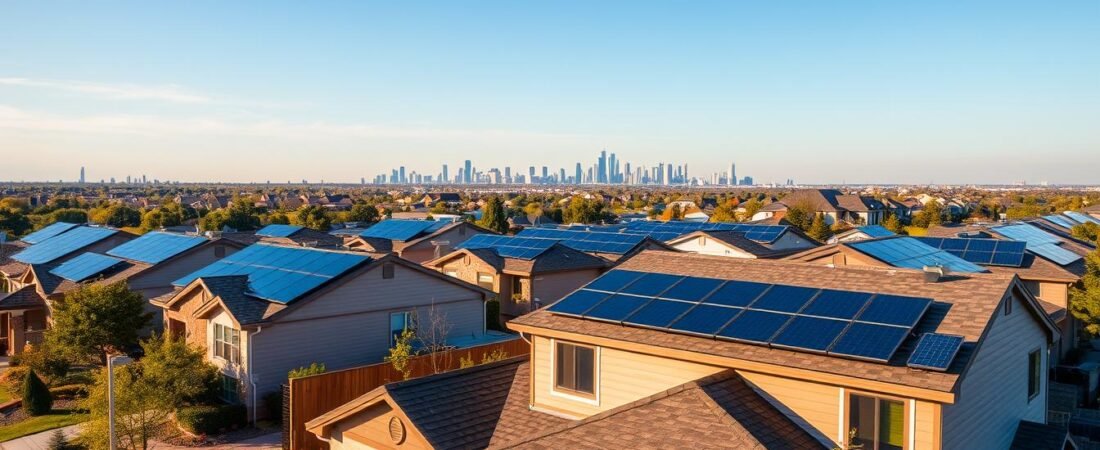
Thinking about a clean energy upgrade? This short guide helps homeowners move from questions to confident decisions. It covers costs, timeline, and the most common financing options so you can compare offers with ease.
Plano gets over 230 sunny days each year, which means a properly sized system can generate meaningful energy for your home. Local firms have built thousands of projects across Texas, showing there is real experience in the area.
We explain how a new set of panels can cut monthly utility bills and boost property value. You’ll learn about upfront cost, long‑term investment, and available incentives that improve savings.
Choosing a reliable company and preparing your roof are key steps. This guide also reviews cash purchase, loans, and other financing options so you can pick the best path for your money and goals.
Ready to get started? Explore local services to compare quotes and timelines: local services.
Why Plano Homeowners Are Switching to Solar Energy
As electricity costs climb, more residents are choosing home systems to regain control over monthly bills.
The financial squeeze is real. Texas rates rose about 23% between 2021 and 2024, moving from 12.1¢/kWh to 14.9¢/kWh. That jump makes predictable on-site power more appealing.
The Impact of Rising Electricity Rates
Higher utility rates push homeowners to consider long-term savings. A typical system today costs roughly $2.15 per watt, which many buyers see as a hedge against future hikes.
Leveraging Texas Sunny Days
With over 230 sunny days per year, local homes can generate meaningful energy. Every sun-rich day boosts total output and helps cut grid dependence during peak summer demand.
| Metric | 2021 | 2024 | Why it matters |
|---|---|---|---|
| Average rate (¢/kWh) | 12.1 | 14.9 | Shows the 23% increase in utility costs |
| Sunny days / year | 230+ | Improves annual energy output for a residential system | |
| Average system cost | $2.15 per watt | Competitive long-term investment vs. rising bills | |
Understanding the Financial Benefits of Plano Solar Panel Installations
Homeowners who add a clean energy system frequently see long-term savings and stronger resale prices.
Real value on resale: A Zillow study shows homes with solar panels sell for about 4.1% more than similar homes without them. In Plano that can mean roughly a $15,000–$25,000 boost in market value for many properties.
Long-term savings: Over a 25-year span, the average homeowner in the area can expect up to $80,000 in avoided utility costs. That makes the initial cost feel more like a long-term prepayment for energy at a stable rate.
- Most owners see solid returns over a 25–30 year system lifetime.
- Offsetting grid use provides a durable hedge against rising electricity prices.
- A well-kept set of panels becomes a tangible asset that helps resale prospects.
To compare local offers and estimated payback for your roof, check trusted providers and get multiple quotes. For a local resource, see trusted Plano providers.
Navigating Local Incentives and Tax Exemptions
Saving on the upfront cost often starts with paperwork. Check local programs and file the right forms to lower your net cost and speed payback.
Property Tax Exemptions for Solar
Texas Tax Code Section 11.27 gives a 100% property tax exemption for the added value from a new system.
To claim it, file Form 50‑123 with your county appraisal district by April 30.
Oncor Residential Rebates
Oncor offers incentives up to $9,000 for systems between 3 kW and 15 kW when paired with battery storage.
That rebate can cut the effective cost and improve your projected savings over the years.
Protecting Your Rights with HOA Laws
Texas law prevents HOAs from banning panels, so you retain installation rights despite aesthetic rules.
If an HOA resists, consult the Texas Property Code or a local attorney to protect your home project.
“Use available tax credit and rebate programs to lower the net cost of your energy system.”
| Incentive | Who files | Deadline / Range |
|---|---|---|
| Property tax exemption (Sec. 11.27) | Homeowner | File Form 50‑123 by April 30 |
| Oncor residential rebate | Oncor customers with battery | Up to $9,000 for 3–15 kW systems |
| Federal tax credit | Tax filer | Available to eligible projects; check current rules |
Comparing Financing Options for Your Solar System
Your financing choice shapes monthly cash flow and lifetime savings for a residential energy system.
Cash, loan, or PPA? A cash purchase gives the best lifetime savings and full tax credit benefits. It raises upfront cost but lowers overall costs long term.
Loans let you go solar with little or no money down. Monthly loan payments can be lower than your current rates, so you may save immediately.
With a PPA or lease, you pay for produced energy at a set rate. That reduces exposure to volatile utility prices and often requires no upfront money.
- Palmetto’s LightReach lease includes maintenance and a 90% production guarantee for the system.
- Leases often pass tax credit value through lower monthly payments.
- Compare total costs, incentives, and expected savings before you decide.
“Carefully comparing financing options ensures you select the best path for your home and long-term financial stability.”
The Step-by-Step Solar Installation Process
A typical home project moves from estimate to activation in a few clear steps that keep surprises to a minimum.
From design to final hookup, each phase is overseen by professionals who handle permits and safety checks.
From Initial Consultation to Final Inspection
Initial consultation: An expert inspects your roof and reviews past energy use to size the system and estimate savings.
- Contract and permits: after you sign, the installer secures local permits and files interconnection paperwork.
- Installation day: the crew mounts racking, wires equipment, and attaches panels. Most homes finish this work in one to three days.
- Inspection and approval: a town inspector verifies safety and code compliance. Final city approval is required before the system can provide power.
The provider keeps you updated at each stage so you know the timeline and any costs that appear. This structured approach helps ensure your energy system is installed correctly and ready to run.
“A clear process reduces delays and gives homeowners confidence that the work meets local rules.”
Selecting the Right Solar Provider for Your Home
Choosing a qualified provider matters as much as selecting the right system size and equipment.
Look for proven experience. Firms like Palmetto, an Elite Installer with 3,810 Texas installs, show consistent customer service and high-quality solar panel work. Solartime USA Inc in Richardson is another top choice that manages everything from consultation to final inspection.
Compare at least three quotes so you can weigh cost, expected savings, and included services. A reputable company will handle permitting, installation, interconnection paperwork, and the final inspection for your system.
- Check certifications, warranties, and verified reviews before you sign.
- Ask for a clear breakdown of cost, performance estimates, and available incentives.
- Confirm maintenance and monitoring details to protect long-term energy production.
“Vetting providers thoroughly helps ensure your energy investment is safe and performs as promised.”
Conclusion
A well‑sized home energy system delivers predictable bills and a clear return on investment over time.
Transitioning to cleaner power is a smart way to manage rising energy costs and boost home value. By combining available incentives, a federal tax credit, and flexible financing, many buyers lower their net cost and speed payback.
This guide gave practical steps to pick a reliable provider, prepare your roof, and track the installation timeline. With more than 230 sunny days per year in the area, your system can deliver steady power for years.
Next step: contact a reputable company for a personalized quote. Compare offers, ask about warranties, and confirm financing or loan options to match your budget.
“Taking action now helps lock in predictable energy costs and protects you from future utility rate increases.”
- Use incentives and tax credit benefits when possible.
- Get multiple quotes to compare cost and expected savings.
- Choose a provider that handles permits and final inspection.
Your investment today can yield lower bills, stronger resale value, and years of reliable energy.
Power Purchase Agreements and Lease Alternatives
If you want immediate bill relief but prefer no ownership responsibilities, a power purchase option may fit.
A power purchase agreement (PPA) lets you buy the electricity a system produces without buying the equipment. The provider owns, maintains, and insures the system while you pay for the energy it delivers at a prearranged rate.
Under a PPA, you often see lower monthly bills right away. The company handles routine maintenance and any repairs, so you avoid surprise costs and upkeep hassles.
PPAs and similar leases are best if you want a hands-off path to cleaner on-site energy. They can be ideal for renters or homeowners who prefer predictable payments without a large upfront expense.
“With a PPA, the provider manages equipment risk while you focus on energy savings.”
- Immediate savings on monthly bills
- No ownership or maintenance duties
- Provider handles repairs and warranty claims
(No H2 in outline for this section, but content required for Net Metering/Lease)
Even without traditional net metering, many homeowners recover value when utilities buy back excess power. These buyback programs apply credit to future bills and reduce out‑of‑pocket costs over the years.
This short guide also notes that you can often go online and qualify for offers that require no upfront cash. That makes switching more accessible on a busy day or tight budget.
Consider estimated tax benefits and the local buyback rate when comparing quotes for solar panels plano. Ask providers to show net savings after incentives and any tax credit.
Takeaway: check buyback terms, factor in incentives, and get a no‑cost quote to see real savings over the next few years.