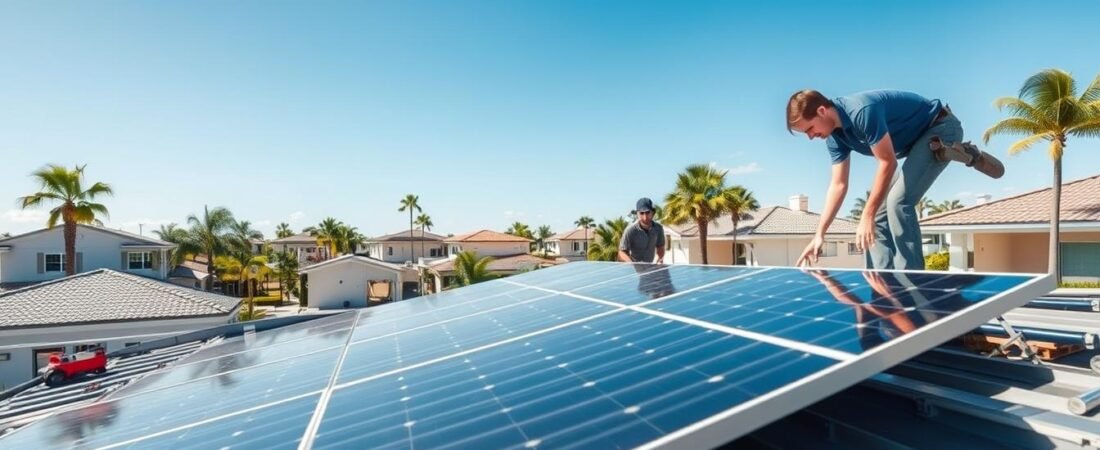
Ready to see if rooftop power makes sense for your home? This guide lays out clear numbers and simple steps to help homeowners weigh the benefits. As of April 2026, the average solar panel system runs about $2.20 per watt, with the typical size at 14.71 kW.
The average upfront price for that system is roughly $32,365 before incentives. With rebates and tax credit options, many people trim the initial outlay and shorten the payback period.
Over 25 years, homeowners in the state often see large long-term savings—about $52,080 on average—while shrinking monthly electricity bills. Typical payback is near 11.09 years, making this a practical investment for many.
Understanding Solar Panel Installation Cost Florida
Understanding what drives a rooftop system’s price helps you budget smartly.
Most of what you pay goes toward equipment, labor, and soft costs, not just the modules. The modules themselves often make up roughly 12% of the total price. Permits, inspections, interconnection fees, and installer overhead are part of those soft costs.
Labor and electrical work add meaningful expense, especially on older roofs or complex arrays. A typical 7.6 kW system averages about $23,100, but your final price depends on home size, energy use, roof condition, and local utility rates.
Compare quotes and equipment options to control spending. Ask installers for a clear itemized breakdown so you see where money goes.
- Modules: ~12% of total
- Soft costs: permits, fees, overhead
- Labor & wiring: installation complexity
| Cost Component | Typical Share | Notes |
|---|---|---|
| Modules (hardware) | ~12% | Quality affects output and warranty |
| Inverter & balance of system | ~20–25% | Impacts efficiency and replacement timeline |
| Labor & wiring | ~30% | Higher for difficult roofs or upgrades |
| Soft costs | ~25–30% | Permits, inspections, interconnection, overhead |
Ready to learn what your home needs? get a quote to see an itemized estimate and compare options.
Average Pricing and System Size Requirements
Comparing offers by price per watt removes much of the guesswork for homeowners. Use that metric alongside expected monthly use to find a system size that fits your roof and budget.
Cost Per Watt Analysis
Price per watt is the standard way to compare quotes. It levels different equipment and labor mixes so you can spot value.
Estimating System Size
A 5 kW system typically runs about $11,002, while a 10 kW setup is roughly $22,005. Doubling size usually doubles the outlay.
- Undersized systems may leave you buying more electricity.
- Oversized systems raise upfront spend without matching savings.
- Use the NREL calculator to tailor size to your household energy use and local sunlight.
| System Size | Approx. Price | Estimated Per Watt |
|---|---|---|
| 5 kW | $11,002 | $2.20 |
| 7.5 kW | $16,503 | $2.20 |
| 10 kW | $22,005 | $2.20 |
For localized figures, check the solar panel cost data to refine estimates and incentives for your area.
Key Factors Influencing Your Total Investment
Several key choices determine how much you’ll invest in a rooftop energy system.
Equipment type matters. Monocrystalline modules give the best efficiency for whole-home use, but they raise the price per watt. Choosing lower-cost options can shrink the upfront bill but may lower long-term output.
Roof orientation and size matter. South-facing roofs in the U.S. deliver the most power, and a larger roof can fit more panels to meet your system size needs.
“Pick components and a layout that match your household energy use to maximize savings over the years.”
- Batteries add $7,000–$18,000 and change your payback timeline.
- Home size and habits set how big a system you need.
- Installer reputation affects design, labor, and warranty support.
- Local climate and utility rates shape actual electricity production and savings.
| Factor | Impact | Typical Range |
|---|---|---|
| Module type | Efficiency vs. price | Low to high |
| Battery add-on | Increases upfront investment | $7,000–$18,000 |
| Roof orientation | Affects yearly output | South-facing best |
| Installer choice | Design, labor, warranty | Varies widely |
Financial Options for Your Solar Project
Choosing how to pay affects monthly cash flow, payback time, and lifetime value. Below are common paths homeowners use to fund a rooftop energy system.
Cash Purchases
A cash purchase means the highest upfront outlay. It also gives the fastest payback and the greatest lifetime savings because you avoid interest.
Solar Loans
Loans are the most popular route. Many loans let homeowners start with little or no money down.
Remember, interest will raise total costs over time, so compare rates and term lengths carefully.
Leases and Power Purchase Agreements
Leases and PPAs let you use on-site power without owning the system. Monthly bills can be predictable, but long‑term savings are lower.
- Cash: best long-term savings, no interest.
- Loan: lowers entry barrier, interest adds to total costs.
- Lease/PPA: low or no upfront cost, less equity and fewer incentives.
“Decide whether ownership or flexibility matters more to your household—ownership maximizes tax and incentive value.”
| Option | Upfront | Typical Benefit |
|---|---|---|
| Cash | High | Max lifetime savings |
| Loan | Low–Medium | Immediate system benefits, paid over time |
| Lease/PPA | Low | Predictable payments, limited incentives |
Available Incentives and Tax Credits
Before you finalize a quote, look for programs that shrink your upfront bill and improve payback.
While the federal 30% tax credit for customer-owned systems ended on December 31, 2025, homeowners still have other ways to reduce the overall expense.
- Florida’s Solar and CHP Sales Tax Exemption (permanent since 2005) removes sales tax on eligible equipment.
- Property tax exemptions keep your annual property taxes from rising because of added system value.
- Many utilities and local governments offer rebates that cut installation costs further.
- Use DSIRE to find up‑to‑date local incentives and eligibility rules.
Tip: talk with your installer to confirm which incentives apply to your system and to capture every available tax credit and rebate.
“Taking advantage of financial programs is a smart way to save money and improve the return on your panels.”
Net Metering and Utility Savings
Net metering converts excess on-site electricity into real dollar value for your home. Net metering turns extra rooftop generation into bill credits you can use later.
How Utility Credits Work
The Florida Public Service Commission set net metering rules in 2008 for investor‑owned utilities. Major companies like Duke Energy Florida and FPL offer rollover credits when your system produces more than you use.
What that means: excess generation is credited to your account and offsets future electricity bills. Over the years, those credits can add up and improve your energy savings.
If you buy power from a smaller municipal utility or co‑op, policies may differ. Always confirm with your provider how credits roll over and whether any limits or fees apply.
“Understanding how your utility handles net metering is a key step in maximizing the financial performance of your system.”
| Feature | Typical Effect | Who Applies |
|---|---|---|
| Rollover credits | Reduces monthly bills | Duke Energy, FPL, many IOUs |
| Credit limits | May cap annual savings | Varies by municipal/co‑op rules |
| Interconnection rules | Required for grid export | All providers |
Hidden Costs and Maintenance Considerations
Planning for maintenance and one-time service needs helps protect your long-term savings.
Check your roof first. A weak roof or needed repairs can add thousands before any system goes up. Roof work often delays projects and raises the overall cost.
If you ever replace the roof, removing and reinstalling panels commonly runs about $3,800 unless your lease or PPA covers it. Older homes may also need a 200-amp service upgrade or extra wiring. Those electrical upgrades can be a major line item.
- Minor upkeep: one or two cleanings a year keeps output steady in dusty areas.
- Watch for hidden fees: loan origination, monitoring subscriptions, or permitting charges.
- Insurance: adding on-site equipment can raise homeowners premiums slightly.
“Planning for these potential costs keeps your investment predictable and protects long-term energy savings.”
| Item | Typical Impact | Estimated Amount |
|---|---|---|
| Panel removal & reinstallation | One-time for roof work | $3,800 |
| Electrical upgrades | Required for older homes | $1,500–$4,000+ |
| Professional cleanings | Maintains efficiency | $100–$400 per visit |
| Ongoing fees | Monitoring, loans, permits | Varies |
Why Professional Installation is Recommended
Hiring a certified crew protects your home and ensures the system meets local code requirements. Working at height and tying into your electric service carry real safety hazards. A trained team reduces those risks and follows required permits.
Safety and Compliance
Roof work and wiring demand experience. Professionals install racking correctly, seal roof penetrations, and connect wiring to prevent fires or leaks.
They also secure permits and pass inspections so your system operates legally and qualifies for local incentives and any tax credit you may claim.
Warranty Protection
DIY installs often void equipment warranties. Certified installers preserve manufacturer and workmanship guarantees.
- Workmanship warranties commonly run 10–25 years and cover installation faults.
- Properly sized systems and correct mounting boost long-term energy production and savings.
- Always verify the installer is licensed and insured before signing a contract.
“Investing in professional service is the best way to protect your equipment and ensure expected performance.”
Conclusion
Choosing the right system size and financing can turn a large upfront decision into steady household savings. Plan around your typical use, compare multiple quotes, and confirm which incentives and tax credit options apply to your project.
Professional installers protect warranties and ensure safe, code‑compliant work. That makes a big difference in long‑term maintenance and performance.
Though the initial cost may seem high, a well‑sized system reduces monthly bills and helps you save money as utility rates rise. Use per watt estimates and clear itemized quotes to judge value.
With careful research and a reliable team, your home will enjoy decades of cleaner energy and measurable savings.