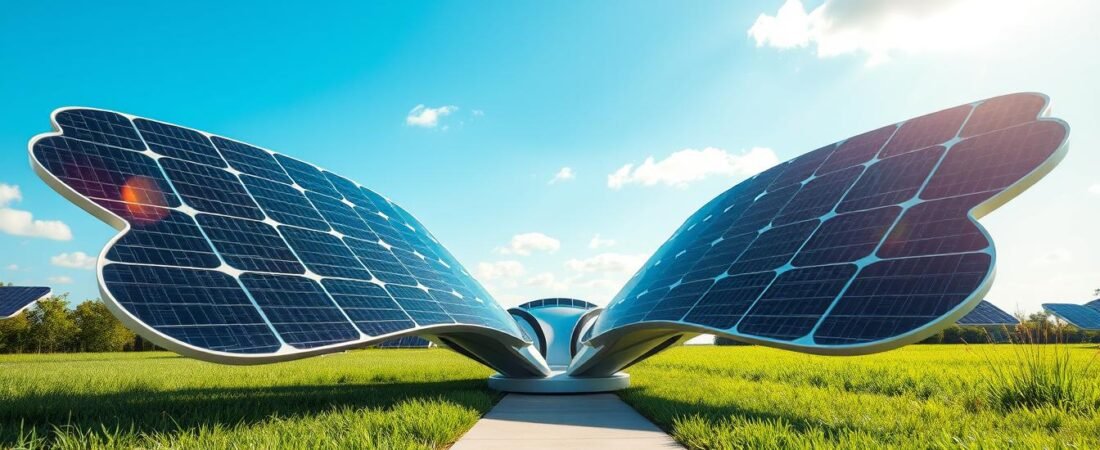
Smartflower systems turn rooftop arrays into a petal-style, ground-mounted unit that tracks the sun all day. Buyers often pay a premium: typical U.S. pricing runs about $25,000–$30,000 (average roughly $27,000) before incentives. This guide looks beyond the look to real-world output and ownership experience.
The review previews how the system performs: manufacturers claim up to ~40% higher production than roof-mounted arrays, with yearly output usually near 3,400–6,200 kWh depending on location. We’ll compare that yield and the net price after incentives to conventional rooftop systems.
Expect clear answers on daily tracking, installation needs, monitoring and cleaning, and how reliability affects long-term value. We’ll weigh aesthetic appeal and conversation-piece benefits against return on investment and practical upkeep.
If you’re collecting quotes, this section sets expectations so you can judge whether the extra price matches the system’s real benefits for your home.
What a “Flower” Solar Panel System Is and How Smartflower Works
A ground-mounted unit opens like a mechanical bloom each morning and follows sunlight across the sky. This sculptural system uses petal-like modules that unfold at sunrise and fold back at dusk.
Solar petals and daily motion
The petals orient toward the sun at about a 90° angle as they open. Homeowners see a dramatic unfold in the morning and a tidy retraction at night. This daily show is often chosen for curb appeal and visibility.
Dual-axis tracking system
A dual-axis tracker keeps the panels aimed at the sun throughout day rather than fixed at one angle. That continuous facing can boost capture of solar energy versus stationary arrays.
Weather protection and practical tradeoffs
The unit monitors wind and storms and will automatically retract if gusts exceed >30 mph to protect moving parts and panels. That protection adds mechanical complexity, which buyers should weigh against the design benefits.
- Daily motion: unfolds at sunrise, retracts at sunset.
- Tracking: follows sun throughout day for higher output.
- Safety: auto-retracts in high winds to protect the system.
| Feature | Fixed rooftop | Tracked ground unit |
|---|---|---|
| Orientation | Single fixed angle | Dual-axis, follows sun |
| Daily visibility | Low | High (unfolds each day) |
| Weather behavior | Passive | Active retraction >30 mph |
| Maintenance & complexity | Lower | Higher (motors, controls) |
Next: How those moving parts and control electronics drive price differences compared with rooftop systems.
Flower Solar Panel Cost: Real-World Price, Cost Per Watt, and Incentives
Before you sign a contract, understand how the sticker price translates to watts and yearly production.
Typical U.S. price: Most buyers see a price range of about $25,000–$30,000, with an average near $27,000 before incentives.
Per-watt explained: Nominally the unit is about 2.5 kW, so the headline is roughly $10 per watt. That helps compare apples to apples with rooftop offers.
Some owners use an “effective” comparison because tracking boosts yield. If output equals a ~4 kW fixed array, effective pricing can drop to about $6.50/W on paper.
“With the 30% federal tax credit, the typical net price falls into the high teens—around $18,900 on average.”
Rooftop contrast: Traditional rooftop solar usually lands far lower per watt (example: ~$3.50/W), since installations skip big moving trackers and use simpler racking.
| Metric | Tracked ground unit | Typical rooftop |
|---|---|---|
| Headline price | $25,000–$30,000 (avg $27,000) | Varies; example ~$10,000 after incentives |
| Nominal $/W | ~$10/W (2.5 kW) | ~$3.50/W |
| Effective $/W (output-adjusted) | ~$6.50/W (compare to ~4 kW) | ~$3.50/W |
| Net after 30% ITC | ~$18,900 | ~$7,000–$10,000 |
If lowest price per watt is your goal, rooftop wins. If you value a visible, all-in-one tracked system and accept higher upfront prices, this system can be a fit.
Next: Cost only tells part of the story—annual kWh production determines real value.
Performance and Energy Production Throughout the Day
Daily energy performance tells you what the system actually delivers to your meter.
Annual output typically runs about 3,400–6,200 kWh per year, with an average near 4,000 kWh. Local sun and weather drive the range, so sunny markets see higher production.
https://www.youtube.com/watch?v=htqvuOoU-5I
How tracking and cooling change the curve
Dual-axis tracking captures morning and late-afternoon sun, shifting output throughout day and boosting total production.
Manufacturers quote up to ~40% more energy than traditional solar panels. Natural airflow under the modules can add another ~5–10% via improved efficiency.
“A typical unit in Los Angeles has been cited near 5,510 kWh per year, showing how location matters.”
What this means for your home
Many homeowners see roughly half of their annual electricity covered by average output. To reach 100% you often need extra rooftop arrays or larger systems.
| Measure | Typical | Sunny market (LA) |
|---|---|---|
| Annual output (kWh) | 3,400–6,200 | ~5,510 |
| Production uplift vs traditional | Up to ~40% | Depends on site, shading, and orientation |
| Cooling benefit | ~5–10% efficiency gain | Better in hotter, well-ventilated sites |
Installation, Space Requirements, and What to Expect on Your Property
Start by measuring usable yard space to confirm the unit’s real footprint. A fully open unit spans about 16 feet in diameter and needs roughly 200 square feet on your property. That footprint matters for setbacks, landscaping, and sightlines from the street.
Footprint and site planning
Compare this ground location with a rooftop option: rooftop systems save yard space but require roof access. A ground-mounted unit offers visibility and avoids roof penetrations, yet uses valuable outdoor space.
Site prep and electrical work
Expect trenching and wiring to connect the unit to your main panel; a licensed electrician must handle the electrical hookup and permits. Mounting typically uses a concrete slab or ground screws for stable anchoring against wind.
Timeline, equipment and certified setup
The device ships assembled and may need a forklift or crane for placement. Once the site is ready, installation can take under an hour, but permits, slab work, trenching, and scheduling certified technicians drive the total timeline.
Tip: Confirm that your dealer includes certified installation and commissioning so the warranty remains valid and the system is programmed correctly.
Features That Affect Value: Tracking, Self-Cleaning, Cooling, Monitoring
Not all add-ons are equal—some boost energy, others only improve convenience. This section breaks down the key features buyers pay for and what they actually deliver.
Self-cleaning brushes
Built-in brushes sweep the panels as the unit opens and closes. Real-world gains are modest—manufacturers cite up to ~2% higher production from reduced soiling.
Who benefits most? Homes near dust, pollen, or busy roads see the biggest upside. Frequent rain zones gain less from automatic cleaning.
Natural cooling design
The elevated mounting lets air flow behind each panel, keeping cells cooler. Cooler cells convert light to power more efficiently.
Productivity lift is typically ~5–10% over a year, depending on heat and ventilation.
App monitoring and controls
Mobile monitoring shows system energy, live output, and weather-driven retraction events. That visibility helps with troubleshooting and service scheduling.
“Tracking plus cooling work together: more sun capture and better conversion.”
Bottom line: tracking and cooling raise production, while cleaning and monitoring improve ownership. Ask dealers what service covers, and weigh these benefits against simpler rooftop options before deciding.
Smartflower Models and Use Cases: Standard, Smartflower Plus, and EV Charging
Model choice shifts this system from a pure production device to a small home energy hub. Buyers typically see three main configurations: the standard unit, the Smartflower Plus with integrated storage, and the EV-ready option that adds a charging port.
Smartflower Plus and hybrid-style operation
The Smartflower Plus bundles a battery and inverter to store generated electricity and support hybrid or limited off-grid use. It can keep critical loads running in outages and shift daytime production to evening use.
Note: off-grid-style does not mean whole-home independence by default. Confirm load planning and whether you need extra inverters or circuits.
Storage options and practical differences
Two common storage sizes are 4.6 kWh and 13.8 kWh. The 4.6 kWh option can power essential lights and a fridge for a few hours. The 13.8 kWh delivers much longer backup and compares in size class to a Tesla Powerwall.
Choose bigger storage if you want meaningful night-time shifting or partial home backup. Smaller packs lower upfront price but limit how much energy you can use after sunset.
EV charging with a dedicated port
The Smartflower EV variant adds a plug-in port for charging an electric vehicle. Charging an electric vehicle directly from midday generation lowers fuel bills and emissions when setup and local rates make it practical.
Real-world note: Many homes still need grid power for full-year coverage. Treat these units as partial offsets unless combined with more generation or larger storage.
“Ask dealers for total installed pricing and what electronics, monitoring, and service are included.”
| Model | Key feature | Typical storage | Best use case |
|---|---|---|---|
| Standard | Production only | None | Design-forward homeowners wanting visible clean energy |
| Smartflower Plus | Integrated battery + inverter | 4.6 kWh or 13.8 kWh | Evening shifting, limited backup |
| Smartflower EV | Dedicated EV port | Optional storage | Owners who want on-site EV charging from daytime production |
For shopping, request total installed pricing by model and ask what the warranty, monitoring, and service cover. For more detail and images, see a concise Smartflower review.
Conclusion
Smartflower solar is a premium, design-forward system that trades lower per watt economics for visibility and convenience benefits.
Expect a headline price near $25,000–$30,000 (avg. ~$27,000) and a net price in the high teens after the 30% federal credit. Typical annual output runs about 3,400–6,200 kWh — often roughly half a home’s use.
On per watt grounds, traditional rooftop solar or conventional rooftop systems usually give more energy for the same budget. The tracked unit wins on placement, curb appeal, and a compact footprint (≈16 ft diameter, ≈200 sq ft).
Who it fits: homeowners with discretionary budget who want a visible renewable feature or who can’t use rooftop arrays. Who should skip it: buyers chasing lowest price, max output, or fastest payback.
Next steps: request quotes for both Smartflower and rooftop options, compare incentives and net price, and ask installers to model annual kWh for your site. Verify installation scope (site prep, trenching, electrician work), service terms, and moving-part warranty before you sign.
Takeaway: If design matters and you accept the premium, this system can be a functional piece of energy art; if pure value is your goal, rooftop solar remains the practical choice.