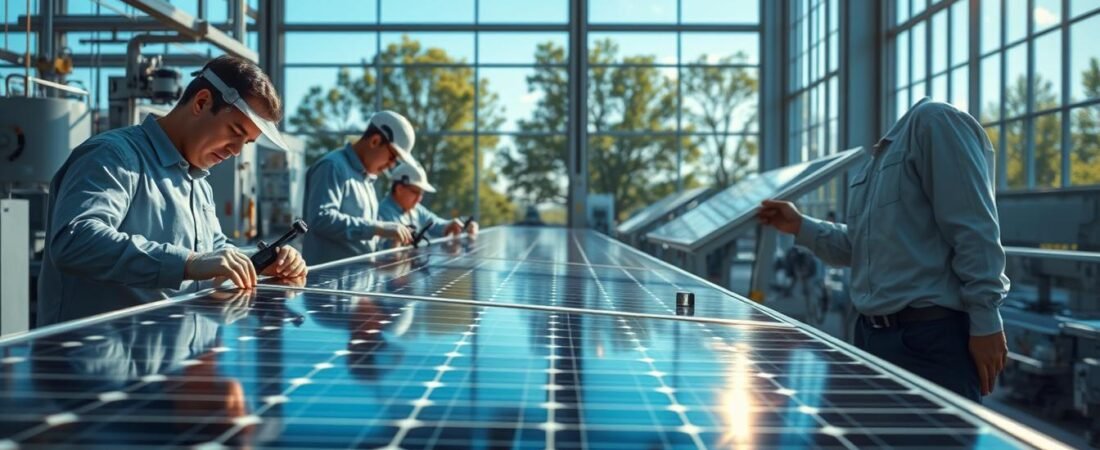
What “top American solar panel companies” means here: this list covers manufacturers with real U.S. production, not just sales offices. That matters for buyers who want job support, steady supply, and access to incentives tied to domestic content.
We preview brands you’ll find: First Solar, Qcells, Canadian Solar, Illuminate USA, and T1 Energy. Some modules are made in the U.S. by global parents, so ownership and factory location can differ.
Use this list by first naming your project type — rooftop, commercial, or utility-scale. Then shortlist manufacturers, and confirm exact model and factory with your installer. This guide focuses on manufacturing capacity, not installer rankings.
Market context: U.S. production is growing fast after the Inflation Reduction Act, but policy timelines and sourcing rules affect availability. We’ll also show practical verification tips — labels, spec sheets, DOE facility lists, and installer questions — so you can confirm what’s truly made domestically. For a full reference, see the U.S. manufacturers list.
Why “Made in America” matters for solar panels in the United States right now
Choosing locally built modules affects jobs, local investment, and project economics — not just pride.
Supporting U.S. jobs, plants, and local investment in clean energy
Domestic manufacturing growth is real: capacity rose 619% and overall panel production roughly quintupled after the Inflation Reduction Act. New plants are reopening cell lines by late 2024, bringing back manufacturing work that had left the country.
That activity fuels local tax revenue and direct investment in communities hosting factories. More plants mean more skilled hiring and downstream services that keep clean energy dollars local.
How American-made solar can affect pricing, payback period, and availability
Locally produced modules can cut shipping time and lower exposure to import delays, which helps installers meet tight deadlines for tax credits. But demand spikes and safe-harbor stockpiling by large developers can still tighten supply for residential installations.
- Pricing: competitive, and incentives can shorten the payback period for homeowners.
- Availability: shorter lead times versus overseas shipping, though shortages are possible.
- Buyer takeaway: ask installers what they can actually source this month or quarter, not just what’s advertised.
Policy-driven bonuses and manufacturing credits shape sourcing decisions, so american-made solar is often a meaningful tiebreaker. Still, compare warranties, expected energy power, and manufacturer bankability before you buy.
What counts as an American-made solar panel (and what doesn’t)
Not every product labeled in-country is equal — the distinction often comes down to where cells and assembly happen.
U.S.-assembled modules vs. U.S.-made solar cells vs. domestic content
“Module assembled in the United States” usually means final assembly and framing happened here, but key parts like cells or glass may be imported.
“Cells made in the United States” means the actual solar cells were produced domestically — a deeper level of production that is still rare.
“Domestic content” is a percentage measure of parts and value added in the united states. Always ask for the bill of materials for clarity.
Why global supply chains still matter
Many panel manufacturers rely on a global supply because upstream steps—polysilicon, wafers, and some specialized processing—remain concentrated overseas.
China still controls most of that upstream production, so U.S. assembly can coexist with imported cells or materials. Qcells, for example, has faced polysilicon sourcing limits and uses overseas suppliers for some inputs.
Where to confirm facility and product origin
- Get the exact model number and request a bill of materials.
- Ask your installer for factory location for that SKU.
- Check manufacturer docs and DOE-aligned facility lists and read detailed reports like this analysis on domestic supply limits: is a 100% made-in-the-usa solar supply chain.
american solar panel companies: top manufacturers by U.S. production capacity
Capacity in gigawatts is the clearest proxy for how much product a manufacturer can realistically supply to the market.
Top five by peak U.S. capacity (GW; main state): First Solar 10.7 GW (OH/AL), Qcells 8.4 GW (GA), Canadian Solar 5 GW (TX), Illuminate USA 5 GW (OH), T1 Energy 5 GW (TX).
First Solar: thin-film for utility projects
First Solar leads U.S. capacity with CdTe thin-film modules aimed at utility-scale power. This technology suits large sites and lowers balance-of-system costs for big projects.
Qcells: Georgia footprint and residential reach
Qcells runs multiple plants in Georgia and is common in residential quotes. Note: specify the U.S.-made line when you request U.S. production.
Canadian Solar, Illuminate USA, and T1 Energy notes
Canadian Solar appears on U.S. lists because of its Texas facility and local hires, even though corporate ties remain global.
Illuminate USA (LONGi + Invenergy) operates an Ohio plant; joint ventures like this show how U.S. manufacturing can pair with global partners.
T1 Energy’s Texas operations reflect joint-venture realities that affect ramp-up, procurement, and continuity—ask installers about exact SKUs and factory origin before you buy.
First Solar: the largest U.S. solar panel manufacturer
First Solar stands out for sheer scale and a deep U.S. production footprint. The company makes roughly 25% more panels than the next-largest U.S.-made brand, giving it a clear lead in domestic manufacturing.
Manufacturing map and capacity
First Solar runs three facilities in Ohio and a plant in Alabama. A fifth site is under construction in Louisiana.
At full output, total capacity reaches about 10.7 GW per year. That scale matters when developers need large deliveries for big projects.
Best-fit projects and technology differences
First Solar primarily produces CdTe thin-film modules rather than typical silicon modules. Thin-film performs well at utility and commercial scale because it lowers balance-of-system costs on large arrays.
For tight rooftop or space-constrained designs, typical silicon modules often fit better. Choose based on system layout, site area, and expected power needs.
Lifecycle, recycling, and procurement notes
First Solar highlights strong end-of-life programs and module recycling—important for multi-decade fleets. Planning disposal or reuse can affect long-term project economics.
Also note: large booked orders and long-term contracts can push lead times. Account for procurement windows during project construction and contract negotiations.
Takeaway: First Solar is a cornerstone of U.S. panel manufacturing. Its plants and scale make it a top choice for commercial and utility developers, but match technology to site and timeline before you commit.
Qcells: a leading choice for residential solar panels with U.S. manufacturing
Qcells has become a common sight in residential quotes thanks to a growing U.S. footprint and installer familiarity. The brand runs four plants in Georgia with roughly 8.4 GW annual capacity, making it the second-largest U.S. manufacturer by capacity.
Georgia plants, capacity growth, and what “made” can mean
Not every Qcells product is built the same. Some modules are assembled in the united states, while others are imported complete. Ask for the exact model number to confirm american-made solar status.
Supply chain notes: polysilicon sourcing
Polysilicon supply has shifted for some lines; Qcells sourced material from Malaysia after a 2024 supplier setback. This affects production timing but is not a reason to panic.
How to ask your installer for U.S.-made modules
Quick script: “Please quote U.S.-made Qcells modules by model number, name the Georgia plant, and add it to the contract line item.”
| Check | What to Request | Why It Matters | Example |
|---|---|---|---|
| Model | Exact SKU | Confirms origin | Q.PEAK X by model |
| Plant | Georgia facility | Verifies U.S. manufacturing | Elberton, GA |
| Warranty | Written terms | Protects long-term value | 25-year output |
| Timeline | Delivery date | Aligns install windows | Ship by Q2 |
Buyer checklist: model number, warranty, plant confirmation, and expected installation timeline. Compare multiple bids—some installers only offer a short list of manufacturers, so shop around to get the exact U.S.-made products you want.
Canadian Solar, Illuminate USA, and T1 Energy: major U.S. plants from global brands
Global firms now power much of U.S. module output by building large local factories. That means a product can be made in the United States even when the parent company is headquartered overseas.
Quick profiles and what the plants mean for buyers
Canadian Solar runs a 5 GW facility in Mesquite, Texas and keeps offices in several states. Its Texas facility is ramping up production and helps serve southern and western markets.
Illuminate USA (Invenergy + LONGi) operates a 5 GW plant in Pataskala, Ohio with 1,000+ employees. Ohio output targets Midwest and Northeast demand.
T1 Energy manages a roughly 5 GW site in Wilmer, Texas. Ownership and JV layers exist, so confirm SKU origin before purchase.
Texas vs Ohio: practical differences
Texas plants often feed Gulf and Sun Belt projects with shorter logistics. Ohio gives faster delivery to Midwest and Northeast buyers.
Remember: nameplate capacity is not instant output. Ramp-up depends on commissioning, hiring, and supply chains. Ask your installer which brand and SKU they can source now, expected lead times, and whether the offered models tie to the stated facility.
Other notable U.S. solar panel manufacturers and expanding plants to watch
Smaller U.S. manufacturers and new plants are quietly reshaping supply options for buyers across regions.
Plants to watch: Silfab, Solar4America, Mission Solar, and SEG Solar run growing U.S. lines that may appear in local quotes depending on inventory and region.
Jinko in Florida — what it means
Jinko’s Florida facility boosts availability for some product lines in the southeastern united states. That helps reduce lead times, but it does not guarantee every model is made there.
Higher domestic content efforts
Heliene teamed with Suniva and Corning to push modules with up to 66% domestic content. For buyers chasing incentive thresholds, that move matters.
“Ask for SKU-level origin and a bill of materials before you sign.”
What to request: exact model number, facility name, and a bill of materials. Also ask installers which brands they can service and warrant long-term, not just what’s cheapest this month.
Credits, policy shifts, and demand can quickly change which plants expand. Keep documentation handy so you can claim any available credit and confirm true domestic content.
Policy and market forces shaping U.S. solar manufacturing in the present
Federal credits and firm deadlines are reshaping supply chains and installer behavior this year. The Inflation Reduction Act lowered the cost of building factories and sped up production by attaching big tax incentives to new output and investment.
45X vs 48C — two routes, different outcomes
45X is a production-linked tax credit that rewards actual module output. 48C offsets the cost of building or upgrading a facility. Firms typically pick one path based on where they want to invest.
Domestic content bonus and installer sourcing
A domestic content bonus (about a 10% ITC uplift) makes U.S.-made components more valuable. Installers may favor models that clear domestic tests to boost project returns.
Deadlines, stockpiling, and global limits
Compressed deadlines (residential credits end 12/31/2025; some commercial windows close in 2027) push buyers to act fast. That spurs safe-harbored orders and stockpiling, which can tighten supply for small installers.
Why global supply still matters
Even as U.S. facilities expand, overseas control of cells and upstream materials keeps prices and availability linked to global markets.
- Practical step: confirm tax eligibility with a qualified tax pro.
- Installers: require written SKU and facility sourcing on contract.
“Require SKU-level documentation and a bill of materials before signing.”
Conclusion
Conclusion
Here’s a quick guide to turn factory capacity into practical choices for your next installation. First Solar leads for utility-scale CdTe; Qcells is the common choice for homes from Georgia lines; and Canadian Solar, Illuminate USA, and T1 Energy power major U.S. plants.
Don’t buy by brand name alone. Ask for the exact model and confirm the manufacturing facility so the panel fits your roof, budget, and expected power needs.
Decision checklist: pick by project type (home, commercial, utility), desired domestic content, budget, and installer availability. Confirm warranties, SKU factory, expected production, system design, and how tax credits and policy affect your incentives.
Next step: compare multiple quotes, ask direct sourcing questions, and choose the manufacturers and installers that best meet your clean energy goals in the United States.